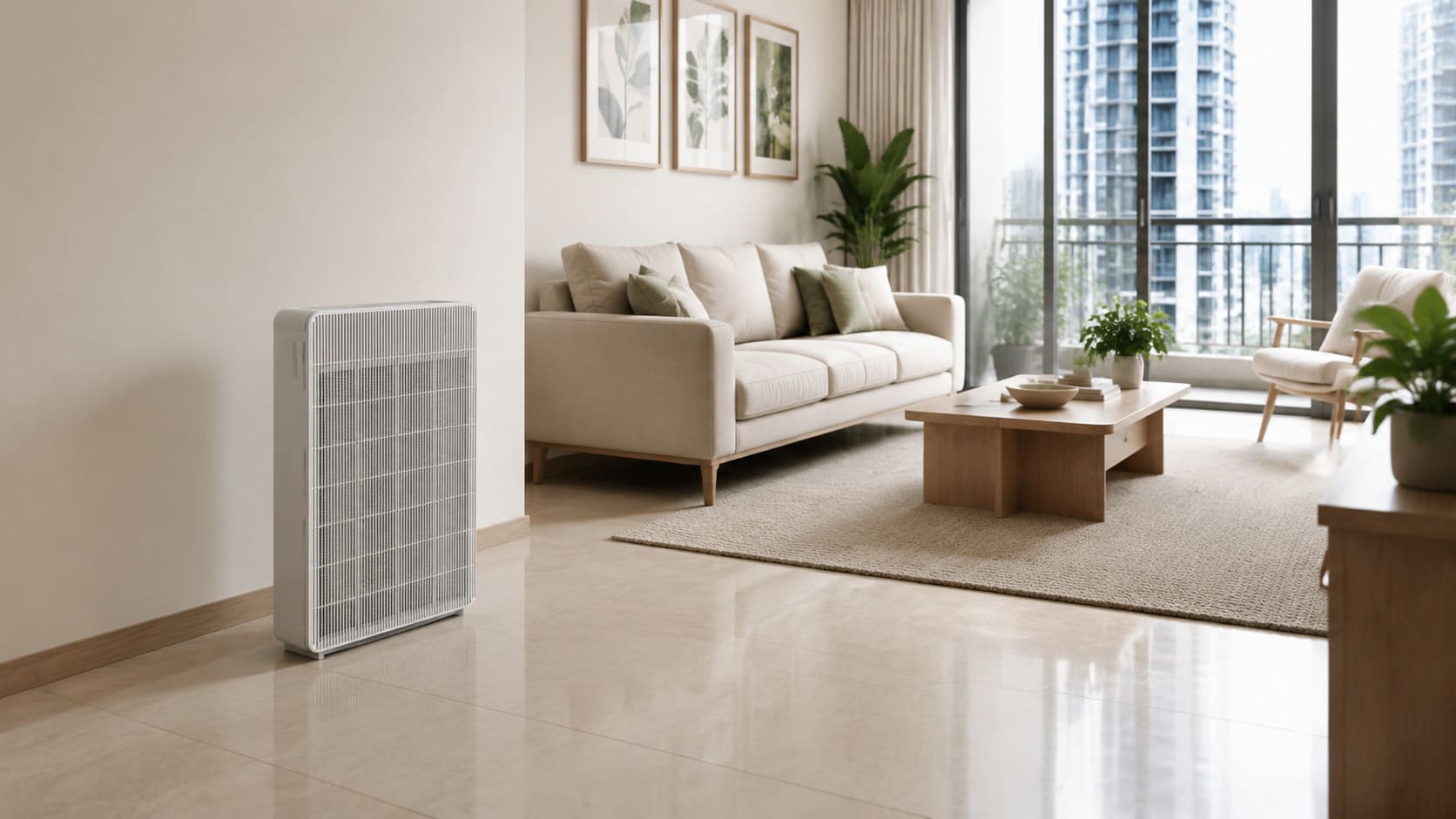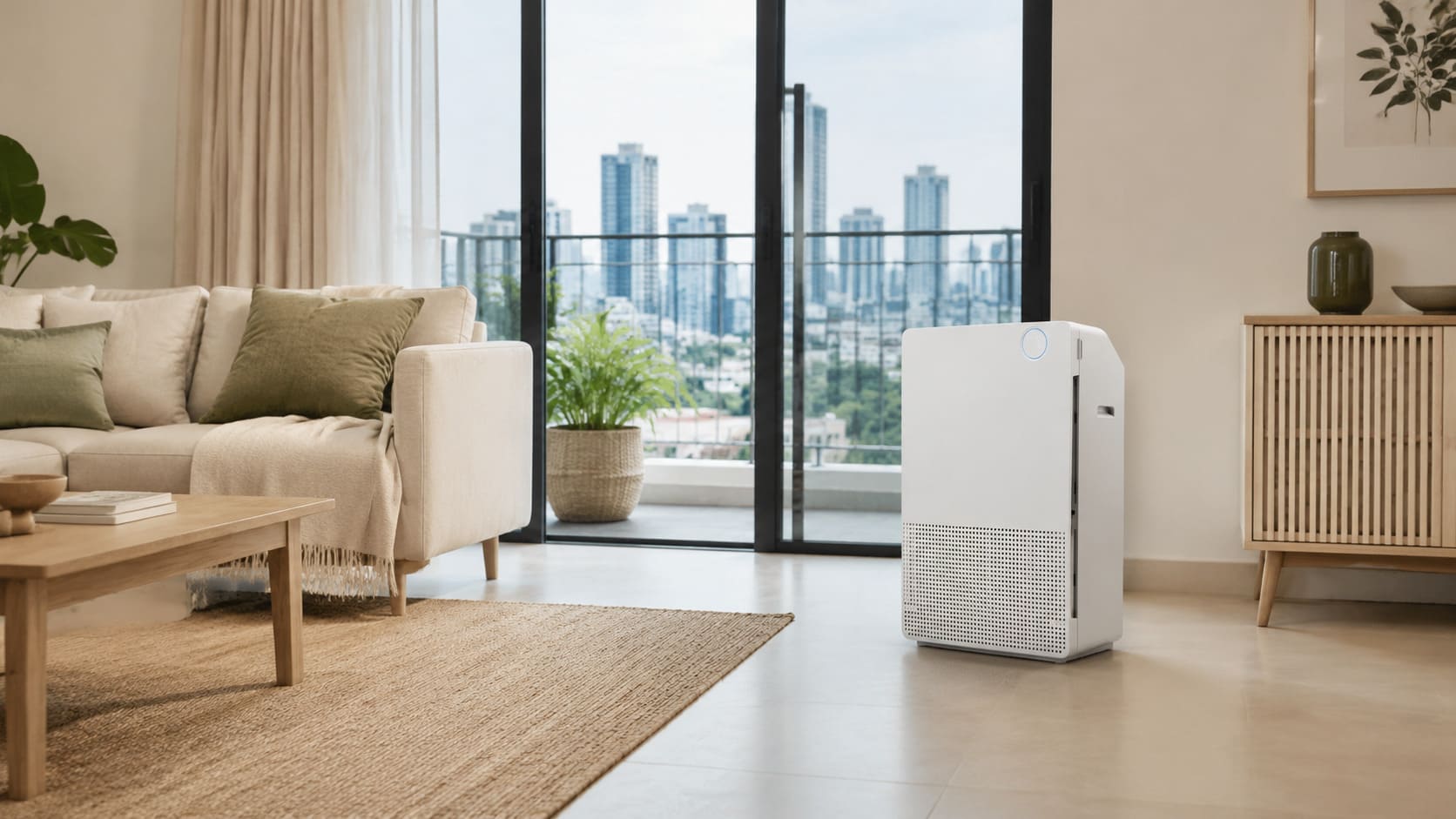
If you live in a compact condo, purifier size matters because you may not have much floor space to spare. In a larger landed home, one machine may not serve several closed rooms. Those two households can look at the same purifier and reach different, equally sensible conclusions.
This guide explains the measurements and practical details worth checking before you buy. It does not rank brands or suggest that an air purifier can replace ventilation, cleaning or medical advice.
1. Begin with the room, not the machine
Measure the room’s floor area in square metres: length multiplied by width. Note the ceiling height if it is unusually high. A double-volume living room contains much more air than a standard bedroom with the same floor area.
Think about doors as well. An open-plan living and dining area may reasonably be treated as one space, while three bedrooms behind closed doors are three separate spaces. Purified air does not move efficiently through walls or closed doors. If your main concern is sleep, a well-sized unit in the bedroom may be more useful than a larger unit left in the hall.
Allow for real-life conditions
Manufacturer room-size guidance is a starting point, but the conditions behind that figure may differ. A room beside a busy road, a home with pets, or a space that regularly opens onto a balcony may introduce particles more quickly. Choosing some performance headroom lets the purifier clean effectively at a quieter middle setting instead of running flat out.
2. Understand CADR without getting lost in numbers
Clean Air Delivery Rate, usually shortened to CADR, describes how much filtered air a purifier delivers over time. A higher number generally means the machine can process more air, but compare figures only when the measurement units and test basis are clear.
CADR is more useful than fan power alone because it considers both airflow and particle removal. Still, it is not the whole story. A powerful machine may be too loud for your bedroom, too large for the available corner, or costly to maintain.
Another useful concept is air changes per hour: how often the purifier can process a room’s approximate air volume in one hour. The appropriate rate depends on the room and your purpose. Treat brand calculators as guidance, and check whether they assume a particular ceiling height or air-change target.
3. Check what the filtration system actually does
Many household purifiers combine several filter stages. A pre-filter catches larger material such as hair and visible dust. A fine-particle filter captures much smaller airborne particles. An activated-carbon layer may help with some odours and gases, although the amount and type of carbon influence how useful it is.
“HEPA” is often prominent in marketing. Look for a clearly stated filter grade or performance standard rather than relying on phrases such as “HEPA-type”. Also check whether independent test information is available and whether replacement filters use the same stated specification.
Filters do different jobs
A particle filter is not automatically an odour solution, and a thin carbon sheet will not behave like a substantial gas filter. If cooking smells are your main concern, source control and ventilation remain important. If visible dust settles quickly, regular cleaning and sealing obvious entry points can reduce the load on the purifier.
4. Plan for haze before the air turns smoky
For a practical operating routine, see how to use an air purifier during haze in Malaysia.
During a haze episode, people often discover that their filter is overdue for replacement or no longer easy to find. Check availability and keep an appropriate spare if your household depends on the purifier during poor-air periods.
Place the unit in the occupied room, keep windows and external doors reasonably closed when outdoor air quality is poor, and avoid activities that create indoor particles. Follow current advice from Malaysian authorities on outdoor air quality and health precautions. An air purifier may reduce indoor particles when correctly sized and used, but it does not make every activity safe or treat a health condition.
5. Listen to noise at the speed that matters
The lowest published noise figure usually belongs to the lowest fan setting. That is helpful for sleep, but the setting may deliver much less clean air. Look for noise and airflow information across several settings if available.
Sound quality also matters. A steady rush of air can be easier to live with than a motor tone that rises and falls. If the purifier is for a child’s room, a work area or a light sleeper, try to hear the machine in person or use recordings only as a rough comparison; microphones and playback devices change how noise sounds.
Bedroom readers can use the focused guide to choosing an air purifier for sleeping spaces. If moisture is the main issue, start with how to choose a dehumidifier.
6. Calculate maintenance before purchase
The purchase price is only one part of ownership. Find the replacement-filter model, current price, expected interval and local availability. Replacement timing varies with usage and air conditions, so a fixed number of months is not a promise.
- Can you clean the pre-filter without special tools?
- Is the main filter stocked through reliable Malaysian channels?
- Does the unit show filter life based on use, or only count time?
- Can you reach the filter easily in the place where the unit will sit?
- What does the warranty cover, and who handles service locally?
A washable pre-filter can reduce larger debris reaching the main filter, but do not wash a filter unless its instructions say that it is washable. Water can damage filter media that is meant to stay dry.
For post-purchase planning, the air-purifier filter maintenance guide explains inspection, cleaning limits and replacement records.
7. Put electricity use in context
Check rated power at different speeds where possible. To estimate energy use, multiply power in kilowatts by the hours used. For example, a 30-watt setting is 0.03 kilowatts; running it for 10 hours uses about 0.3 kilowatt-hours. Your actual cost depends on the applicable tariff and how the machine changes speed.
Do not choose on wattage alone. A very small purifier running at maximum may provide less useful clean air—and more noise—than a properly sized model at a moderate setting.
Use the air-purifier electricity guide to convert the product wattage and your operating hours into monthly kWh.
8. Leave room for air to move
A purifier needs clear intake and outlet paths. Avoid squeezing it tightly behind a sofa, under a desk with little clearance, or against curtains. Follow the manufacturer’s spacing instructions.
For a bedroom, position it where air can circulate without blowing directly at your face. For a living area, a reasonably open location is usually more effective than a hidden corner. Keep the cable away from walkways and make sure children or pets cannot easily pull the unit over.
If moisture is the main concern, first compare a dehumidifier and air purifier; the two appliances perform different jobs.
9. Match features to the household
Condos and apartments
Prioritise a compact footprint, sensible cable placement and a display that can dim at night. Measure the intended spot, including room needed to remove the filter. If cooking and living areas share one space, remember that a purifier is not a substitute for an extractor hood or ventilation.
Homes with pets
A good pre-filter and easy access matter because hair can build up quickly. Air purification may help with airborne particles, but it will not remove hair from floors or furniture. Regular vacuuming remains part of the routine.
Children and older family members
Look for stable construction, a child lock if useful, simple controls and a quiet night setting. Avoid interpreting general product claims as medical advice. If someone has asthma, allergies or another health concern, ask a qualified healthcare professional about their individual needs.
Larger families
More movement, open doors and daily activity can change indoor conditions. Decide which room deserves priority and whether two sensibly placed units would work better than expecting one machine to cover the whole home.
A practical buying checklist
- Measure the actual room and note ceiling height.
- Check CADR in consistent units and the assumed room conditions.
- Confirm the fine-particle filter specification.
- Decide whether odour or gas filtration is genuinely important.
- Compare noise at useful fan speeds, not only sleep mode.
- Find the replacement-filter code, price and Malaysian stockist.
- Check access for cleaning and filter replacement.
- Review power use at the settings you expect to run.
- Plan a clear, safe location for intake and outlet airflow.
- Read warranty terms and local service arrangements.
Choose for the room you live in
A well-chosen purifier should fit quietly into a household routine. It needs enough airflow for the room, filters you can obtain, controls people will actually use and maintenance that does not become a burden.
Start with those ordinary details. Extra sensors and app features can be convenient, but they should come after the fundamentals—not replace them.
For a worked sizing estimate, use the room-size and CADR calculator with your own ceiling height.
Frequently asked questions
What CADR should I choose for my room?
Start with the room’s floor area and ceiling height, then compare CADR figures stated in the same units and under clear test conditions. Some performance headroom can let the purifier clean effectively at a quieter middle speed.
Can an air purifier help during haze in Malaysia?
A correctly sized purifier with suitable fine-particle filtration may reduce airborne particles indoors. Keep windows and external doors reasonably closed when outdoor air is poor, maintain the filter and follow current advice from Malaysian authorities.
Does a HEPA filter remove cooking smells and odours?
A particle filter is not automatically an odour filter. Activated carbon may help with some odours and gases, but its amount and type matter. Source control, an extractor hood and ventilation remain important for cooking fumes.
Where should I place an air purifier?
Place it in the occupied room with clear space around the air intake and outlet. Avoid hiding it behind furniture or curtains, and do not expect one unit to clean several closed rooms. Follow the manufacturer’s clearance instructions.

Jason Lim
Tech & Appliance Contributor
Jason looks beyond marketing claims to explain filtration, energy use and appliance features in clear, practical terms. View Jason’s profile.