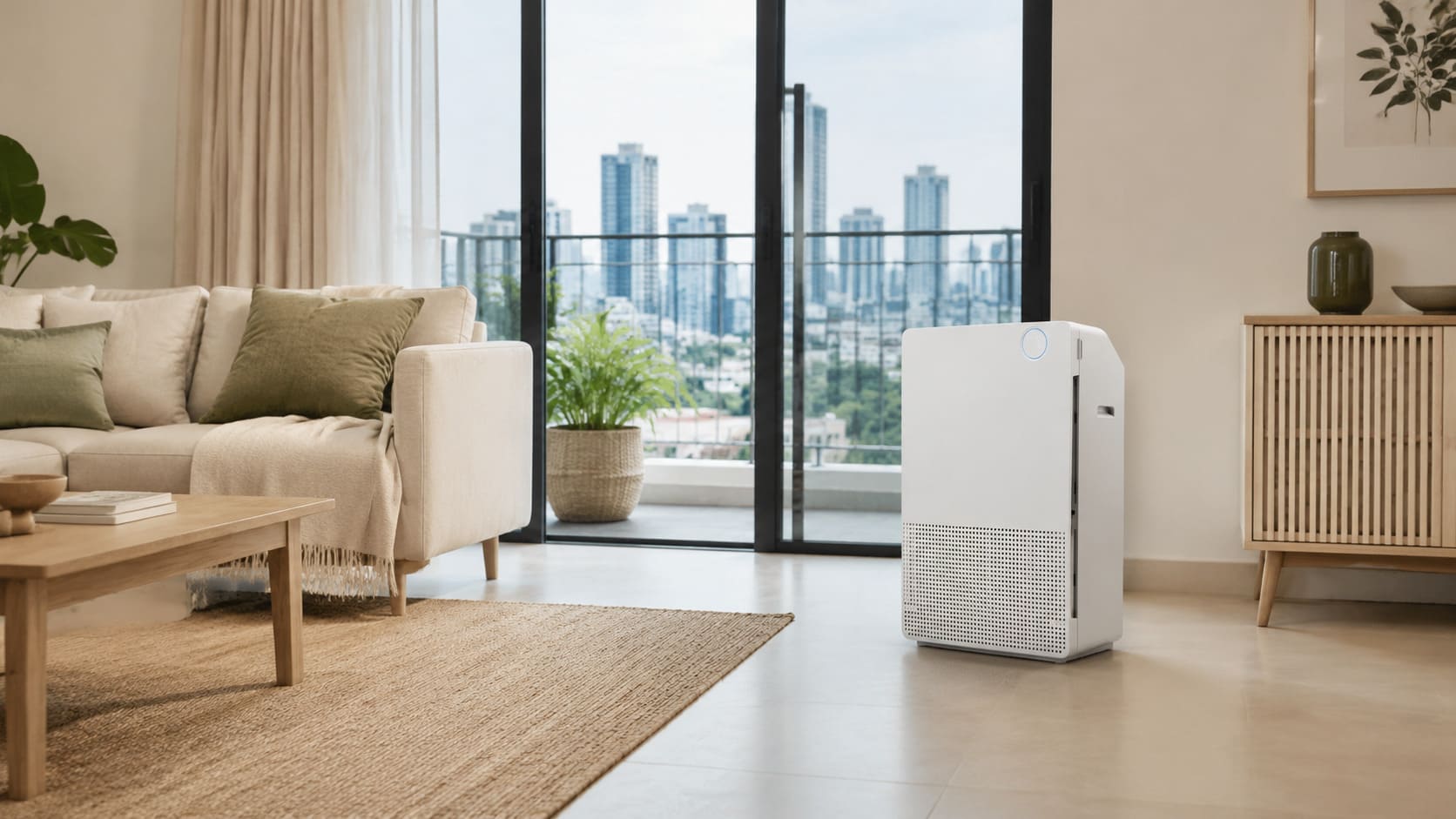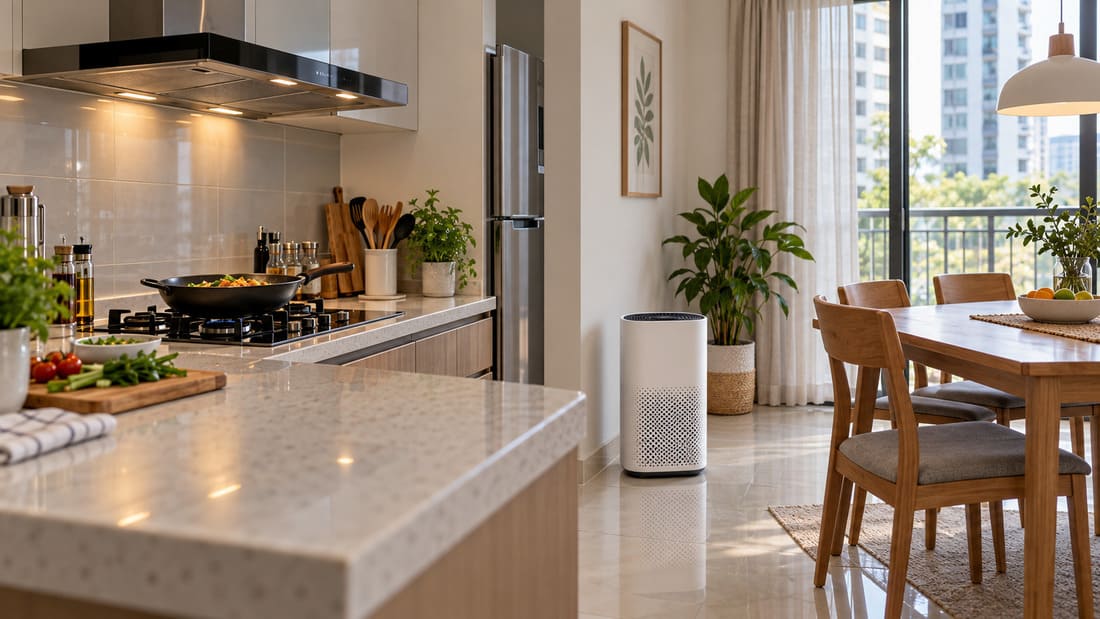
An air purifier with suitable activated carbon or other gas-filtering media may reduce some cooking odours. A particle filter alone does not remove odour gases. Start with effective extraction and the source of lingering smells, then use a purifier as additional help—not as a replacement for kitchen ventilation.
Cooking particles and cooking smells are different
Cooking can release airborne particles as well as gases. A particle filter, including a HEPA filter, targets particles passing through it. Odour-causing gases need a different type of filter material, such as activated carbon.
This is why a purifier can improve its particle reading while you still notice last night’s cooking. A particle sensor does not establish that all odour gases have gone, and a fresher-smelling room does not prove that every pollutant has been removed.
Think about the problem you want to solve before shopping. Is visible cooking haze spreading into the dining area, or does a smell remain after the air looks clear? You may need to improve more than one part of the kitchen routine.
Start above the hob
EPA’s cooking guidance recommends using the range hood whenever you cook and using back burners where practical to improve capture. An effective hood exhausting outdoors carries captured emissions out of the home. A recirculating hood returns filtered air indoors, so it performs a different job.
Check which arrangement your kitchen actually has. A hood on the wall does not tell you whether there is an outdoor exhaust duct. Ask the landlord, installer or building management if the route is unclear; do not assume you can add or alter ducting in a condo without checking.
Use the hood according to its instructions and keep its filters maintained. If it seems unusually weak, noisy or greasy, have that problem checked before expecting a portable purifier across the room to compensate.
Where appropriate, ventilation with clean outdoor air can help. Take local haze, traffic pollution and weather into account rather than opening every window automatically. Electric cooking can still generate particles from food and oil, so extraction remains useful even without a gas flame.
Look past the words “carbon filter”
Activated carbon captures certain gases on its surface. Its performance depends on factors including the material, amount, gas involved and operating conditions. It has a finite capacity and cannot be assumed to remove every cooking gas indefinitely.
EPA’s consumer guide notes the importance of having a substantial amount of gas-filtering material. A brief mention of carbon in a product description does not tell you how it will handle repeated frying in your kitchen.
Ask the seller for the gas or odour test behind the claim, the test conditions and the replacement-filter details. Check whether the result describes a particular gas in a test chamber or actual cooking odours. A percentage without the substance, time period and test setup gives you little basis for comparison.
The familiar smoke, dust and pollen CADR figures describe particle cleaning. Do not treat a high particle CADR as proof of equally strong odour removal. Our room-size calculator helps with particle capacity; it does not calculate carbon-filter life or guarantee smell removal.
Use the purifier where it can work safely
Choose a location permitted by the appliance manual, away from hob heat, splashes and direct grease spray. Leave the specified clearance around its air openings. Do not put it on a cooking surface or squeeze it into the gap beside a hot pan.
In an open kitchen and living area, consider the whole connected space when checking particle capacity. Keep the purifier’s airflow from interfering with the cooker hood’s capture or blowing across a flame.
Choose a usable fan setting rather than judging performance only in a very quiet night mode. Keep expectations realistic: there is no universal number of minutes after dinner that will clear every room. For more placement detail, see air-purifier placement in a condo.
Try a simple before-and-after-dinner routine
- Before cooking: check the hood is ready and switch it on as directed. Keep the portable purifier in its usual safe position.
- While cooking: use suitable heat for the food and oil, and avoid unnecessary smoking or burning. Use the back burners when practical and compatible with safe cooking.
- After cooking: follow the hood’s run-on guidance. Once surfaces are safe to handle, clean food and grease residue and deal with the rubbish.
- Later: check whether the remaining smell is coming from the bin, dishes, textiles or another nearby source before increasing purifier speed again.
If you want to judge whether your setup helps, keep brief notes over comparable meals. Changing the dish, cooking method, windows and fan settings all at once makes the difference hard to interpret. A household smell comparison is useful feedback, but it is not a laboratory performance test.
A lingering smell is not always a sizing problem
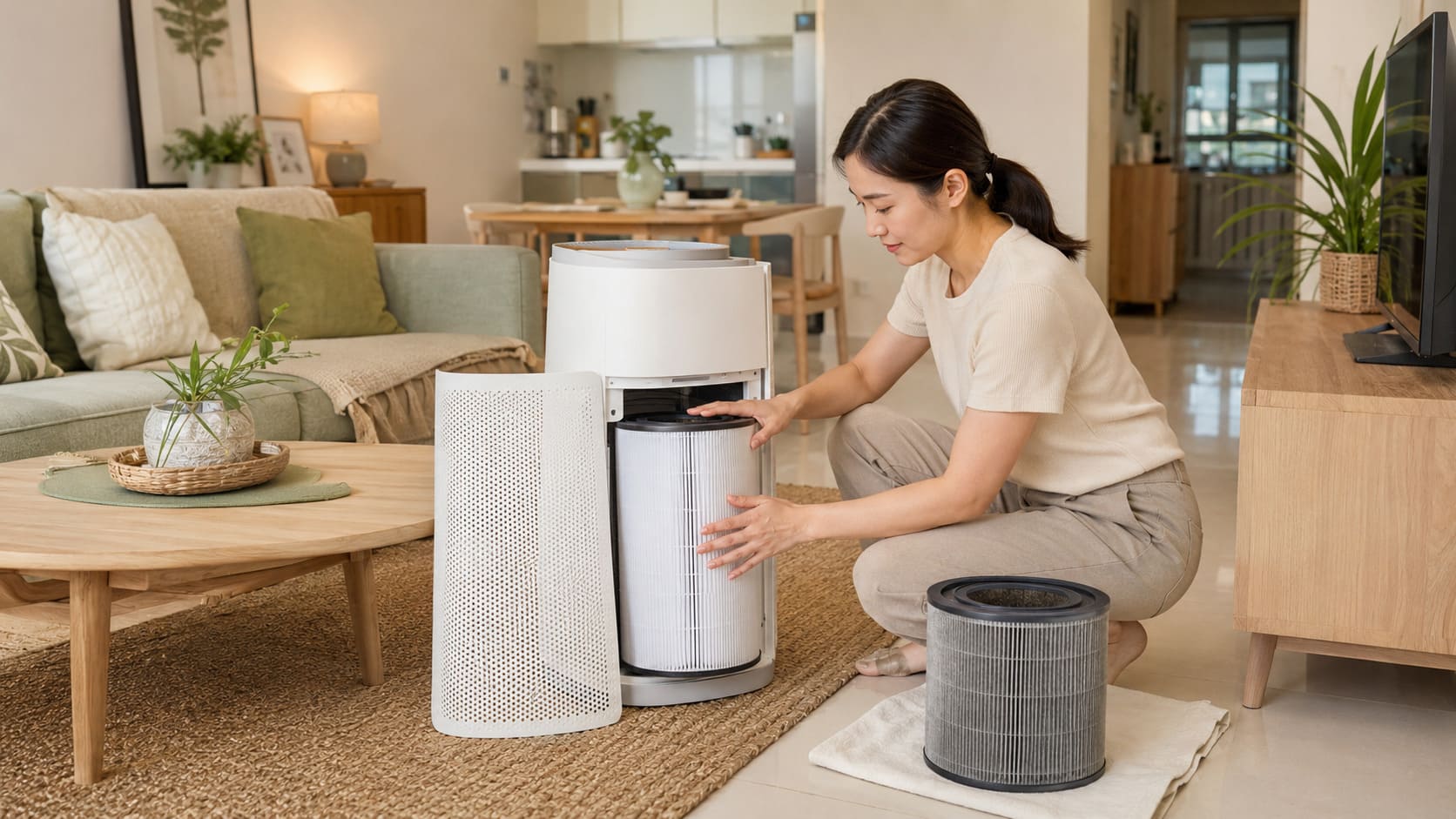
Check the hood, bin and cleaning routine first. Then inspect and maintain the purifier as its manual directs. A particle-filter indicator should not be assumed to measure how much odour capacity remains in the carbon media.
Confirm whether the replacement cartridge includes the same gas-filtering stage as the original. Do not wash, heat or attempt to regenerate a filter unless the manufacturer explicitly permits that procedure. Keep replacement availability and cost in the buying decision; our filter-replacement guide covers the practical checks.
A purifier is not a remedy for a suspected gas leak or a substitute for required combustion ventilation and safety measures. Treat an unusual gas smell as a separate safety issue and follow the gas supplier’s emergency guidance.
When buying one is worthwhile
A purifier is most useful here as an addition to a working kitchen routine, especially when cooking particles reach the space where you sit. If odour is the main reason for buying, ask for evidence about the gas-filtering stage before paying more for an otherwise powerful particle cleaner.
If the kitchen has poor extraction or an unresolved source of smells, address that first. For a broader comparison of room coverage, noise and ownership costs, continue with the air-purifier buying guide.
Frequently asked questions
Will a HEPA-only purifier remove frying smells?
It can capture airborne particles that pass through the filter, but HEPA filtration alone does not remove odour gases. Check whether the appliance also has a suitable gas-filtering stage.
Can an air purifier replace a cooker hood?
No. A portable purifier does not capture and exhaust cooking emissions at the hob in the way an appropriately installed outdoor-venting hood does. Treat filtration as supplementary.
Sources and further reading
Sources checked on 11 October 2026.
- US EPA: guide to air cleaners in the home (PDF)
- US EPA: improving indoor air quality while cooking
- US EPA: sources of indoor particulate matter
- US EPA: residential air cleaners technical summary (PDF)