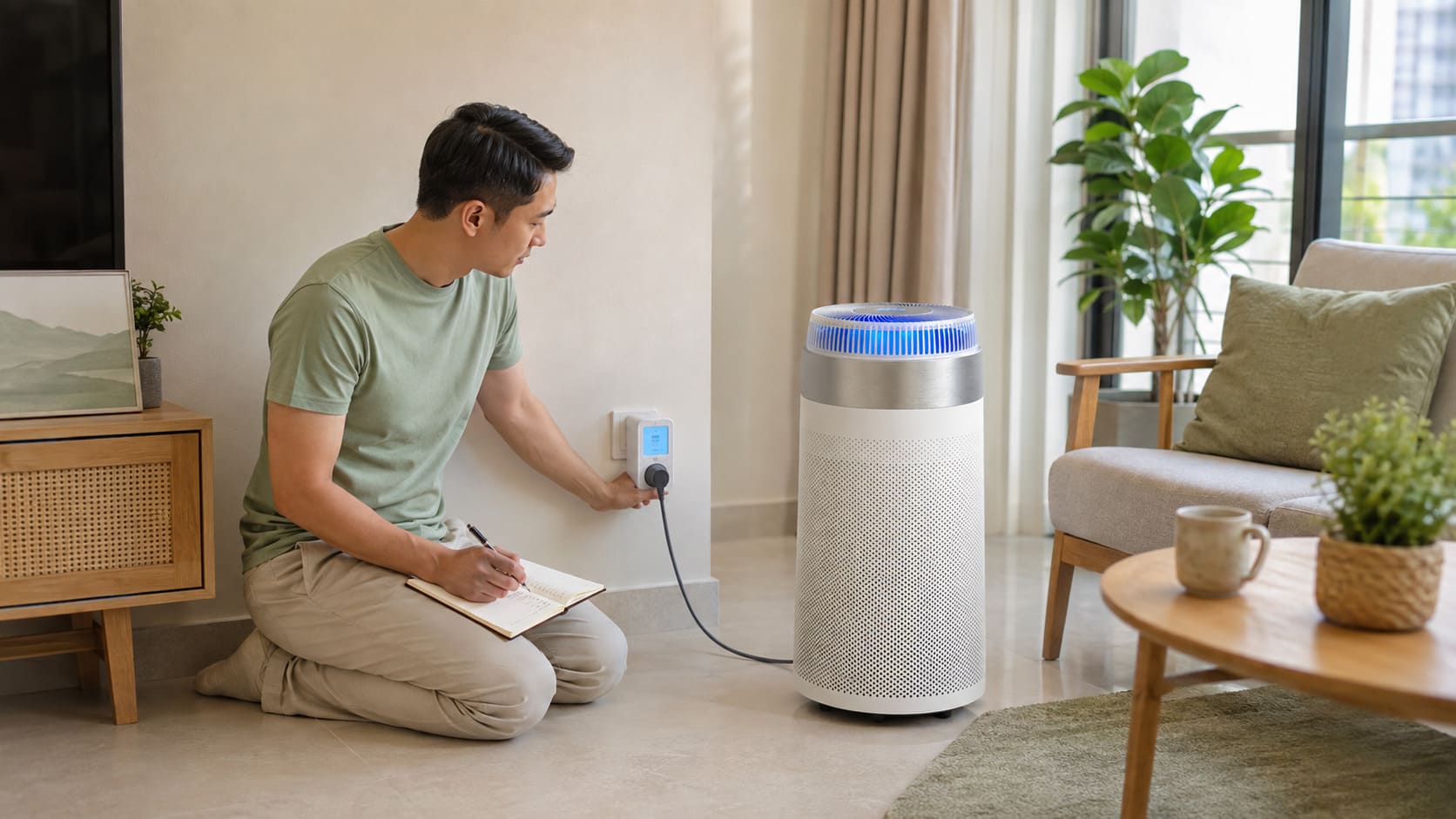
Air-purifier electricity use is straightforward to estimate when you know the input power and operating time. The difficult part is avoiding a false promise: fan speed changes consumption, automatic modes vary and the household bill may use changing tariff components.
Find the purifier’s rated or measured watts, multiply by operating hours and divide by 1,000 to obtain kilowatt-hours. For a 30-day estimate, multiply that daily figure by 30. Apply the current relevant electricity rate separately rather than relying on an old online cost figure.
1. Find the correct power figure
Look for input power or power consumption on the rating label, manual or official specification. Do not confuse watts with voltage, frequency, CADR or a maximum value for another function such as heating.
Some purifiers draw different power at low, medium and high fan speeds. A unit with additional heating, cooling, humidification or other functions should be calculated for the mode actually used.
2. Convert watts into monthly kWh
Tenaga Nasional Berhad gives the household calculation as power in watts multiplied by hours of operation and 30 days, divided by 1,000. The result is monthly electricity consumption in kilowatt-hours.
Monthly kWh = watts × hours used per day × 30 ÷ 1,000
| Example input | Daily use | Monthly consumption |
|---|---|---|
| 15 watts | 8 hours | 3.6 kWh |
| 30 watts | 12 hours | 10.8 kWh |
| 50 watts | 24 hours | 36 kWh |
These are arithmetic examples, not typical-product claims. Use the exact wattage and operating pattern for your purifier.
3. Convert consumption into cost carefully
Multiply the estimated kWh by the relevant current rate or use the current official bill calculator. The final bill can depend on household consumption bands, tariff components, taxes, rebates or other rules, so a single universal ringgit figure can mislead.
When comparing two purifiers, calculate both over the same operating hours and fan-speed assumption. Electricity is only one ownership cost; replacement filters and servicing may be larger or less predictable expenses.
4. Understand fan speed and automatic mode
Higher fan speed normally moves more air and can draw more power. It can also deliver more filtration. Running permanently at the lowest speed may reduce electricity use but may not provide the intended clean-air delivery for the room.
Automatic mode responds according to the machine’s sensors and programming. Two homes can produce different results because particle levels, doors, cooking, haze and operating behaviour differ. Use a plug-in energy meter only if it is appropriately rated and used safely.
5. Choose runtime from the air-cleaning need
The US Environmental Protection Agency notes that higher speeds and longer running times generally increase the amount of air filtered. Set runtime from room size, occupancy and air conditions, then calculate the energy consequence. Do not reduce operation below a useful level merely to obtain an attractive cost estimate.
During haze, follow current Malaysian advice and the haze operating guide. A severe particle period may justify longer operation and more frequent filter checks.
6. Compare total running cost
- Electricity at the operating speeds you will actually use.
- Particle and gas-filter replacement prices.
- Availability of replacement media in Malaysia.
- Scheduled servicing or sensor cleaning.
- Warranty terms and out-of-warranty repair.
- Whether one correctly sized unit replaces several undersized units.
The filter replacement guide explains why household conditions affect maintenance intervals.
7. Use a repeatable worksheet
Record low and high wattage, hours per day, monthly kWh, current tariff source, filter cost and replacement assumption. Date the worksheet so you know when tariff and product information was checked. This produces a transparent estimate that can be updated later.
For the separate household tariff decision, read whether TNB Time-of-Use suits your routine.
Frequently asked questions
Does an air purifier use a lot of electricity?
It depends on wattage, speed, operating hours and any additional functions. Calculate the exact appliance rather than assuming every purifier has the same consumption.
How do I calculate monthly air-purifier electricity use?
Multiply watts by hours used per day and by 30, then divide by 1,000. This gives estimated monthly kWh.
Is automatic mode always cheaper?
Not necessarily. It depends on the sensor, control logic and room conditions. Compare measured or documented consumption over a realistic period.
Should I run an air purifier all day?
Runtime should reflect room size, occupancy, air conditions and manufacturer guidance. Longer operation filters more air but increases electricity use and filter loading.
Sources and further reading
- Tenaga Nasional Berhad: usage cost of electrical appliances at home
- US EPA: Guide to Air Cleaners in the Home
- Energy Commission Malaysia: energy-using products and electrical safety compliance

Daniel Wong
Budget & Value Contributor
Daniel compares household costs with clear assumptions, equal time periods and attention to the full ownership commitment. View the contributor information.