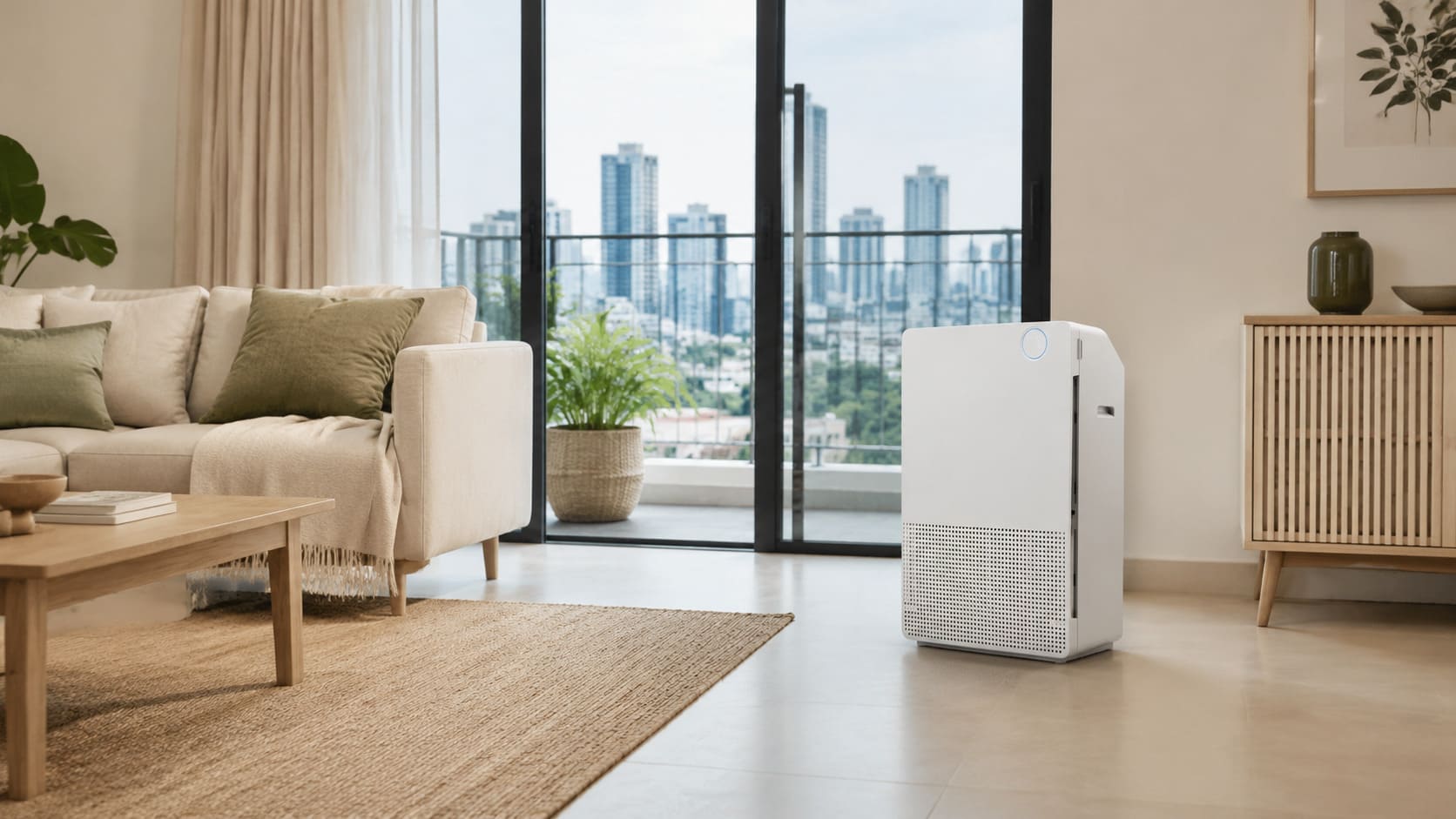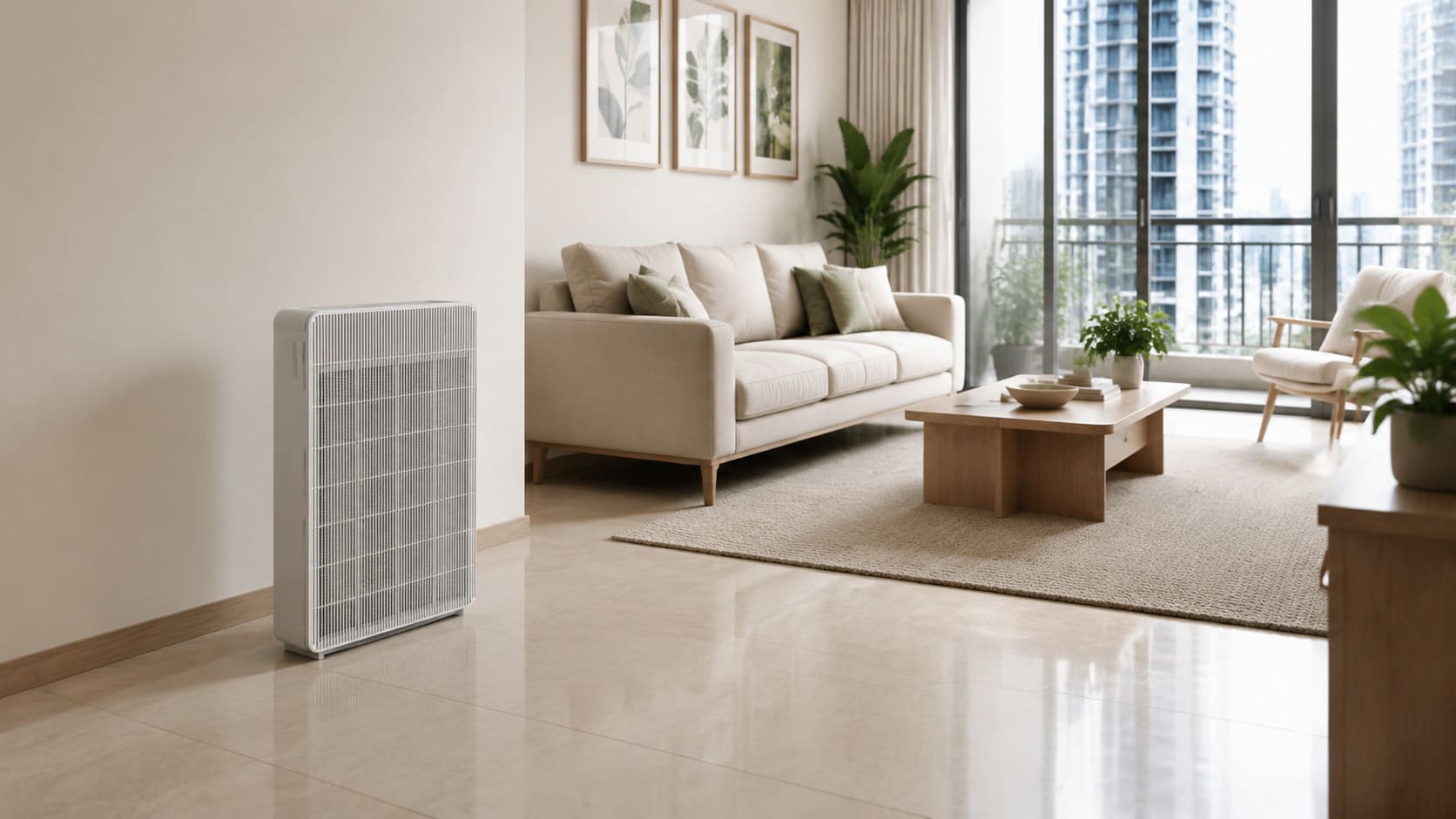
Condo rooms often ask one appliance to fit around a sofa, curtains, storage and walking space. Tucking a purifier into the least visible corner may look tidy but can restrict the air it needs to move.
Put the purifier in the room where people spend the most time, leave every intake and outlet clear according to the manual, and avoid hiding it behind furniture or curtains. One unit should not be expected to clean several closed rooms.
1. Choose the room before the exact spot
A purifier works on the air that reaches it. Closed bedroom doors, corridors and walls limit movement between rooms. If there is one unit, prioritise the occupied room where filtration matters most—often a bedroom at night or the main living area during the day.
Moving a portable unit can be reasonable when it is easy and the purifier has time to operate in the new room. Constantly moving a heavy unit may become a routine the household stops following.
2. Follow the actual airflow path
Some models draw air from the back, others from the sides, bottom or all around. Clean air may leave from the top or front. Use the manufacturer’s stated clearance rather than a general distance copied from another machine.
| Position | Possible issue | Better check |
|---|---|---|
| Against a wall | Rear or side intake may be restricted | Required clearance for the exact model |
| Behind a sofa | Furniture blocks airflow and access | Move beside an open edge |
| Under curtains | Fabric can cover the intake or outlet | Keep clear throughout the curtain movement |
| Inside a cabinet | Air recirculates in a confined space | Use an open position unless designed for built-in use |
3. Place it for comfortable bedroom use
Keep the outlet from blowing uncomfortably at the face or directly disturbing bedding and papers. Consider display brightness, control sounds and fan noise. A slightly less central position may be more usable if it allows a quieter speed and uninterrupted sleep.
Do not create a trip hazard with the power cable. Keep the unit stable, away from wet areas and with enough room for filter removal.
4. Work with the living-room layout
Choose an open edge near the occupied zone rather than the smallest decorative corner. Kitchen fumes should first be managed with source control and suitable extraction; a particle purifier does not replace a cooker hood or ventilation.
For pet areas or recurring dust, place the purifier where room air can reach it without putting the intake directly against loose fur, litter or a dusty surface that causes rapid loading.
5. Balance filtration with ventilation
Ventilation brings outdoor air in; a portable purifier recirculates and filters indoor air. They are not interchangeable. Malaysia’s Ministry of Health recommends ventilation with clean outdoor air when practical, while recognising that windows may need to remain closed when outdoor air quality is poor or weather does not allow.
Use our Malaysian haze air-purifier guide for a room-by-room operating checklist.
During haze or another period of poor outdoor air, check current official advice. When conditions improve, suitable ventilation remains important for pollutants and moisture that a purifier may not address.
6. Test the position for several days
- Confirm no intake or outlet is blocked.
- Check whether doors, curtains or furniture move into the airflow.
- Listen at the speed you will use at night.
- Make sure the filter can be removed without moving heavy furniture.
- Check the cable and walking route.
- Observe whether the position is convenient enough to use consistently.
If you are still choosing a machine, start with our Malaysian air-purifier buying guide to understand room size, CADR, filtration, noise and maintenance.
Frequently asked questions
Can I place it against a wall?
Only when the manual allows it and all intakes and outlets remain clear.
Bedroom or living room?
Prioritise the occupied room where filtration matters most. One unit does not reliably clean several closed rooms.
Can I hide it behind furniture?
Avoid any location where furniture or curtains restrict airflow or prevent filter access.
Should windows stay open?
Use suitable ventilation when outdoor air is acceptable. During poor outdoor air, follow current Malaysian guidance and avoid continuously bringing polluted air inside.
Sources and further reading
- Ministry of Health Malaysia: ventilation and indoor-air-quality guidance
- Ministry of Health Malaysia: residential ventilation guidance note

Alicia Lee
Condo & Lifestyle Contributor
Alicia looks at footprint, noise, placement and how household products fit a real modern condo. View Alicia’s profile.