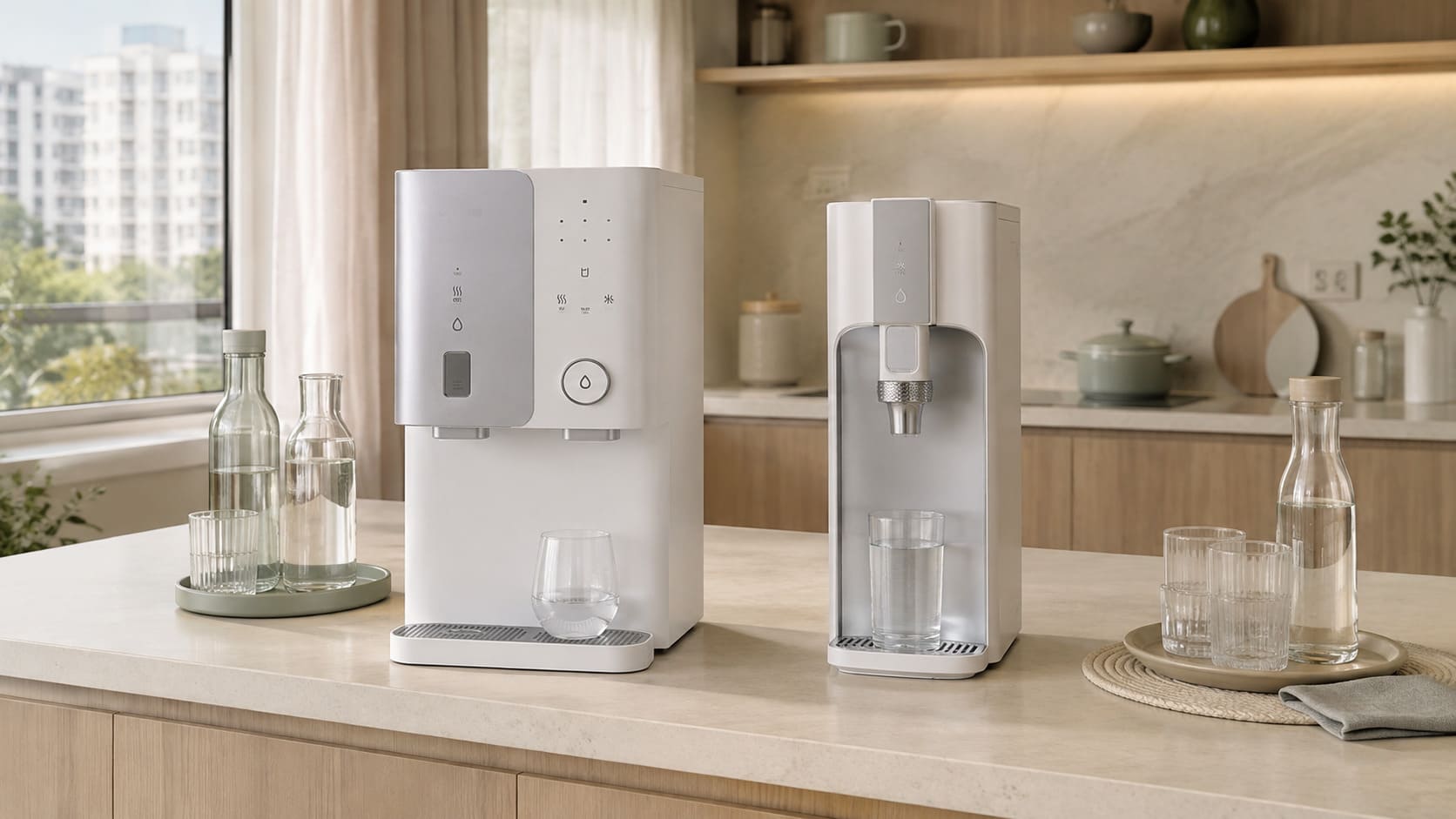
Tank and tankless describe how a water purifier manages dispensing, not whether its filtration is automatically better. A tank model keeps a quantity of water ready inside the machine. A tankless model generally heats or cools water closer to the moment it is dispensed.
That difference affects waiting time, footprint, power behaviour, cleaning and how well the appliance handles several users in a row. This guide compares the formats rather than brands or individual products.
For the complete selection process beyond format, read our guide to choosing a water purifier in Malaysia.
1. What “tank” and “tankless” mean
A tank purifier stores filtered water in one or more internal reservoirs. Depending on the design, separate tanks may keep hot, cold or ambient water ready. Capacity varies, so the specification should state how much water is available at each temperature.
A tankless purifier reduces or removes those storage reservoirs. Water travels through the treatment and temperature system when requested. Some models may still contain small internal chambers or waterways, so “tankless” should not be interpreted as meaning that no water remains anywhere inside the appliance.
Neither format tells you which contaminants a filter is designed to reduce. Check the actual filtration stages, test standard, replacement schedule and local water conditions instead of treating the format as a health claim.
2. Compare the real installation footprint
Tankless machines are often chosen for compact kitchens because their bodies can be slimmer. Width is only part of the measurement, however. Check depth, height, door or filter-clearance space, ventilation gaps and the room needed to place a cup or bottle under the outlet.
A larger tank appliance may be easy to accommodate in a dry kitchen but awkward on a shallow condo counter. An under-sink or directly plumbed installation also needs a suitable water point, drainage arrangement where required, an accessible power socket and permission for any cabinet alteration.
- Measure width, depth and height at the intended position.
- Allow space to open covers and replace filters.
- Check the distance to the water inlet and electrical outlet.
- Confirm whether drilling or cabinet work is required.
- Keep hot-water outlets beyond the easy reach of young children.
3. Think in dispensing patterns, not family size alone
A household of five does not always use more purified water at one time than a household of two. The important question is whether demand arrives gradually or in a rush.
A storage tank can provide its ready volume quickly, but temperature may change after the stored supply is depleted while the appliance recovers. A tankless system does not depend on a large stored volume, although dispensing rate and temperature can vary by design. Check how much hot or cold water the machine can deliver continuously—not only its first cup.
Situations worth testing
- Several bottles filled before school or work.
- Hot drinks prepared for visiting relatives.
- Repeated use during meal preparation.
- A large flask filled in one session.
- Users selecting different temperatures one after another.
4. Check temperature performance carefully
Labels such as hot, cold and ambient do not provide enough detail. Look for stated temperature ranges and ask whether they apply at the outlet, inside a tank or under particular test conditions.
For instant heating, the selected temperature and flow rate may influence each other. A slower flow can give the heater more time to raise the temperature. For stored hot water, the available volume and recovery time matter. If the appliance will be used for preparing infant formula, medicine or a task requiring a specific temperature, follow the relevant professional or product guidance rather than relying on a colour-coded button.
Hot-water dispensers also require sensible placement and safe controls. Check for a child lock, understand how it works, and never assume that a lock replaces supervision.
5. Maintenance matters in both designs
A storage tank adds surfaces that may need periodic sanitation. A tankless appliance has less stored water, but it still contains tubing, valves, filters and dispensing components that require care. Neither format is maintenance-free.
Ask who performs scheduled servicing, what is cleaned or replaced, how often visits are expected, and what happens if an appointment is missed. If maintenance is handled by the household, read the instructions before opening or washing any component.
Safe handling remains important after treatment. The World Health Organization treats household water safety as a chain that includes treatment and storage; a clean outlet, clean containers and hygienic handling still matter.
6. Understand how electricity is used
A tank model may cycle heating or cooling to maintain stored water temperatures. A tankless model may draw more power for a shorter period while heating on demand. The label “instant” does not by itself prove that total electricity use will be lower.
Compare rated input, standby behaviour, energy-saving modes and your likely dispensing pattern. An appliance used for frequent hot drinks may behave differently from one used mainly for ambient water. Malaysian regulators list household hot-and-cold water dispensers among regulated electrical equipment with applicable safety standards, so check for the required local approval and use a suitable socket.
7. Calculate the full commitment
Purchase price or monthly rental is only the beginning. Put all required costs on the same timeline before comparing options.
- Upfront payment, deposit or installation charge.
- Monthly rental and the full contract duration.
- Filter replacements and scheduled servicing.
- Early-termination, relocation or reinstatement charges.
- Electricity use and any consumable cleaning parts.
- Warranty length and what happens after it expires.
A lower monthly figure can represent a higher total commitment if the agreement runs longer. Conversely, an outright purchase may require the owner to arrange and pay for maintenance separately. Read the current written terms rather than relying on a verbal summary.
8. A practical side-by-side view
| Question | Tank format | Tankless format |
|---|---|---|
| Stored water | Keeps a stated volume ready | Usually stores little or no dispensing volume |
| Back-to-back demand | Fast until ready volume is used; recovery then matters | Continuous ability depends on heating, cooling and flow design |
| Footprint | Often larger because of reservoirs | Often slimmer, but installation clearance still matters |
| Cleaning | Tank sanitation may be required | Internal waterways and outlet still require care |
| Power behaviour | May cycle to maintain stored temperatures | May use higher power briefly during on-demand heating |
| Best question to ask | How much is ready, and how long is recovery? | What flow and temperature can it sustain? |
9. Which format may suit your home?
A tank purifier may suit you if:
- Your household frequently fills several cups or bottles together.
- You value water being ready at a stable temperature.
- You have adequate counter or floor space.
- The tank-cleaning and service plan is clear and manageable.
A tankless purifier may suit you if:
- Counter space is limited.
- You prefer to minimise stored water.
- Your typical demand is one or two servings at a time.
- You have checked real dispensing speed and temperature performance.
These are tendencies, not rules. A well-designed model can behave differently from the general pattern, so evaluate the exact specifications and service terms before deciding.
Questions to ask before installation
- What filtration claims are supported by test information?
- How much hot, cold and ambient water can be dispensed continuously?
- What happens after the ready supply is depleted?
- Who sanitises the system, and what does the service include?
- Are filters readily available in Malaysia?
- What electrical and plumbing work is required?
- What is the complete cost over the contract or expected ownership period?
- Can the unit be relocated if you move home?
Choose around the routine you already have
The tank-versus-tankless decision is mainly about delivery and daily use. Start with the number of people drawing water at the same time, the available space, the temperatures you genuinely use and the maintenance arrangement you are prepared to follow.
Only then compare filtration performance, written service terms and total cost. A shorter feature list that fits the household is usually more useful than an impressive specification that does not match the routine.
Frequently asked questions
Is a tankless water purifier automatically more hygienic?
No. A tankless model stores less dispensing water, but its filters, tubing, valves and outlet still need proper cleaning and servicing. Hygiene depends on the complete design, maintenance schedule and everyday handling—not the label alone.
Does a tankless water purifier always use less electricity?
Not necessarily. Tank models may cycle to maintain stored temperatures, while tankless models may draw more power briefly during on-demand heating. Compare rated input, standby behaviour and expected daily use for the specific model.
Which format is better for a large family?
Family size alone does not decide it. A tank model can serve several cups quickly until its ready volume is used; a tankless model depends on its sustained flow and temperature performance. Compare both against your household’s busiest dispensing period.
What should I measure before installing a water purifier?
Measure the available width, depth and height, then allow clearance for ventilation, filter changes and filling bottles. Also check the water inlet, suitable power socket, drainage needs and whether drilling or cabinet work is required.
Sources and further reading
- Ministry of Health Malaysia: Drinking Water Quality Standards and Frequency of Monitoring
- World Health Organization: Guidelines for drinking-water quality
- Energy Commission Malaysia: regulated household water dispensers

Jason Lim
Tech & Appliance Contributor
Jason translates filtration systems, appliance specifications and maintenance requirements into practical household decisions. View Jason’s profile.