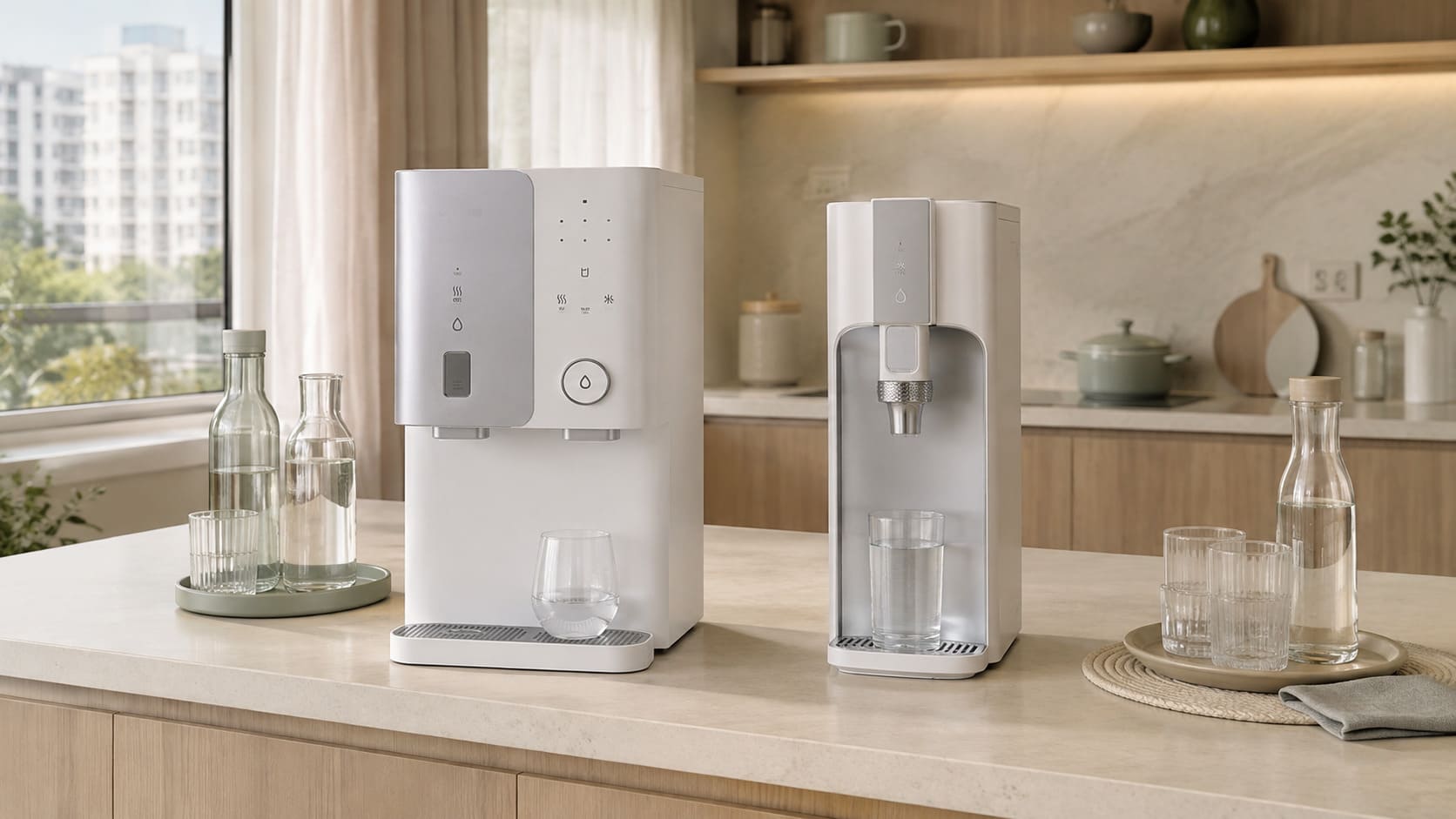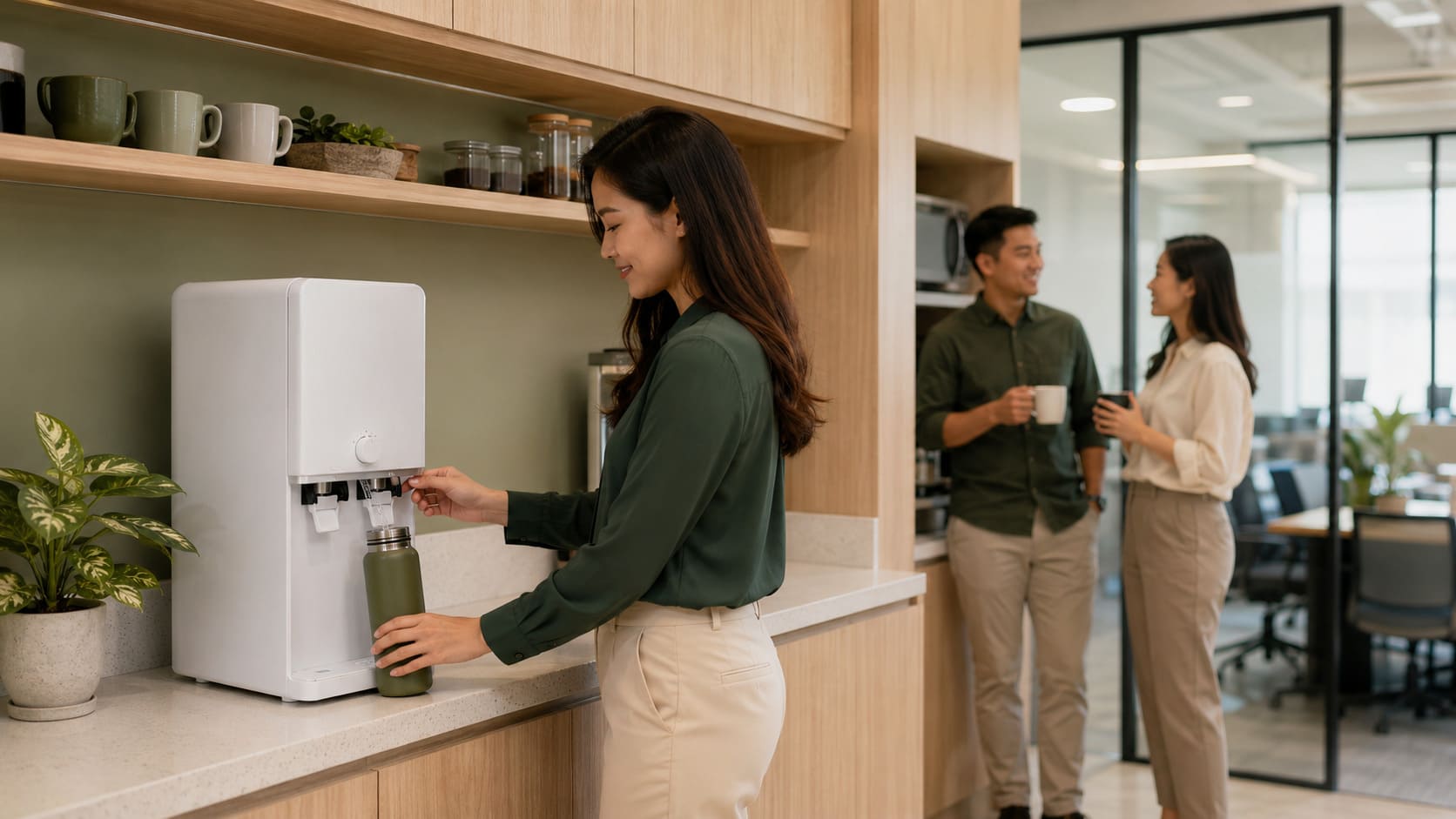
A purifier that feels fast for one household can become frustrating when ten people fill cups and bottles at once. Office selection should begin with usage, service response and downtime—not appearance alone.
Count staff and visitors, map the busiest periods, compare ready-water volume or continuous flow, and confirm that the product, warranty and service plan allow the intended workplace usage.
The complete Malaysian water-purifier guide explains filtration, installation and service questions before workplace capacity is added.
1. Count users and peak periods
Record regular staff, visitors, meeting-room demand and any pantry use for hot drinks. The daily total matters, but the busiest 15 to 30 minutes often reveals whether the machine can keep up.
| Workplace pattern | Question | Feature to examine |
|---|---|---|
| Morning bottle filling | Can several people dispense without a long wait? | Flow, ready volume and recovery |
| Lunch and hot drinks | How quickly does hot water recover? | Heating method and hot-water capacity |
| Frequent visitors | Are controls obvious without training? | Labels, cup area and dispensing sequence |
| Meetings | Can demand be handled away from the main queue? | Location or a second dispensing point |
2. Confirm workplace suitability
Do not assume a household model is approved for repeated office use. Ask whether the manufacturer permits the intended number of users and whether commercial or workplace use changes the warranty, service interval or product support.
The Energy Commission lists regulated electrical-equipment categories, including several types of household water dispenser. The product supplied to an office should have appropriate documentation for its actual category and use.
3. Compare format with demand
A tank model may dispense ready hot or cold water quickly until stored volume is used. A tankless model may reduce footprint but depends on continuous flow and heating or cooling performance. Read our tank-versus-tankless guide for the format details.
For a larger team, one higher-capacity unit is not always the only answer. Two sensible dispensing points may reduce queues and improve access, but they also double some installation and maintenance tasks.
4. Plan a safe, accessible location
- Use suitable water, power and drainage connections where required.
- Keep the walkway clear and control loose cables or hoses.
- Allow enough space for filter changes and repairs.
- Provide a stable cup area and manage spills promptly.
- Keep hot-water controls understandable and away from accidental contact.
- Avoid placing the machine where a queue blocks doors or work areas.
5. Treat service response as part of capacity
A machine that is unavailable affects many people. Ask how faults are reported, typical service coverage, whether a replacement unit is offered, and how filters and preventive maintenance are scheduled.
Keep a visible service record with the model, filter stages, last visit, next due date and contact details. Nur Aisyah’s maintenance checklist provides a simple household record that can be adapted for an office.
6. Calculate cost per working arrangement
Compare purchase or rental payments, installation, filters, service labour, repairs, electricity, relocation and likely downtime. A low monthly figure may still represent a long commitment. Daniel’s rental-versus-buying guide explains how to compare the full term.
7. Office checklist
- Staff, visitor and meeting demand recorded.
- Peak dispensing period tested against stated performance.
- Workplace use permitted by the product and service terms.
- Installation route and service access confirmed.
- Hot-water and spill risks considered.
- Filter supply and service response clear.
- Full contract or ownership cost compared.
- A responsible person assigned to keep records and report faults.
Frequently asked questions
What capacity does a small office need?
There is no universal figure. Count users and compare the busiest period with ready-water volume, continuous flow and recovery time.
Can an office use a household purifier?
Only when the manufacturer, warranty and service terms permit the intended usage and the capacity is suitable.
Rent or buy?
Compare the full term, servicing, repairs, filters, response time, relocation and ownership conditions.
Where should it be installed?
Use an accessible, stable position with suitable connections, clear service access and no queue, cable or spill hazard.
Sources and further reading
- Ministry of Health Malaysia: Drinking Water Quality Standards and Frequency of Monitoring
- Energy Commission Malaysia: regulated electrical equipment

Ahmad Zulkifli
Workplace & Business Contributor
Ahmad looks at capacity, durability, servicing and whether an appliance remains practical when many people use it. View Ahmad’s profile.