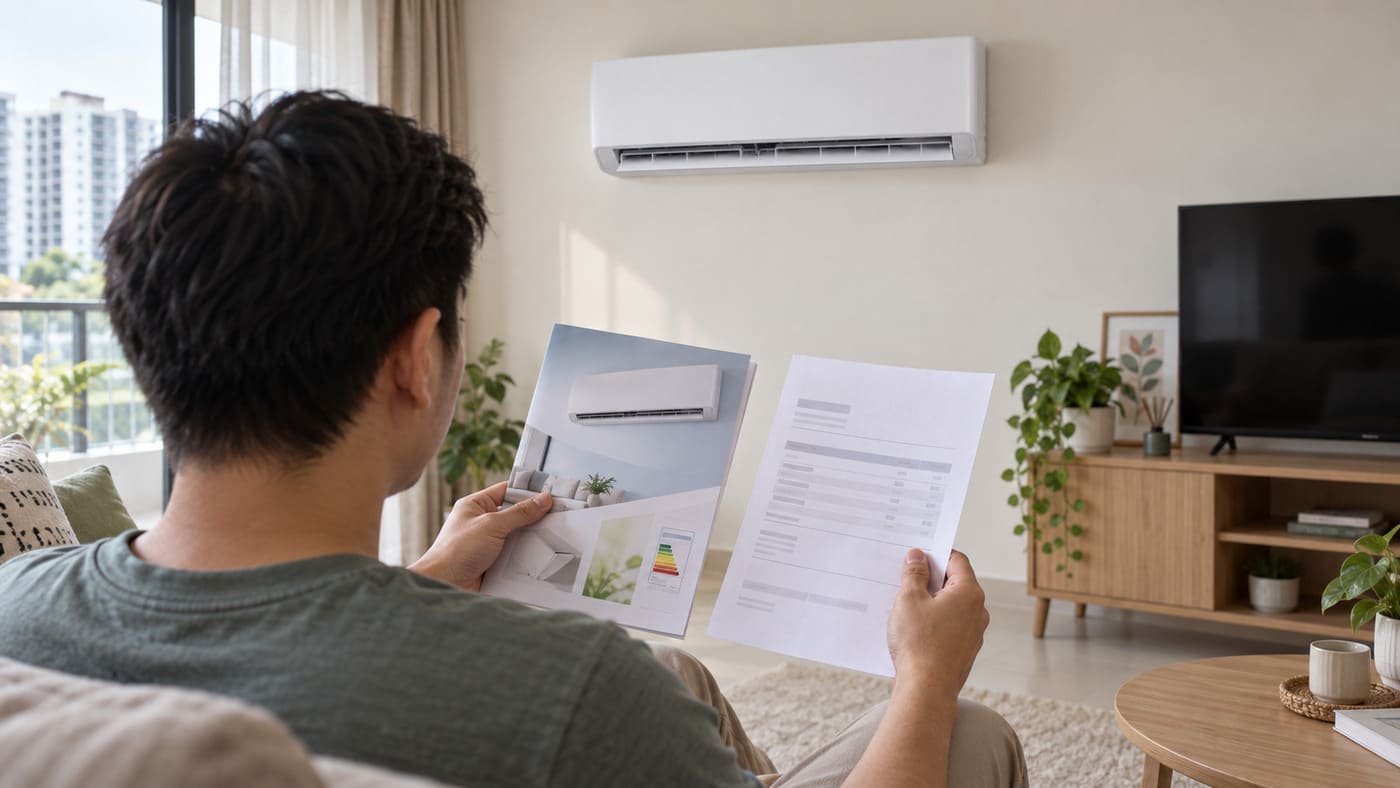
Before choosing a replacement unit, use this aircond room-sizing checklist to prepare the measurements and room details for an installer.
Try the existing aircond’s dry mode if you want less humidity and can accept its effect on room temperature. A separate dehumidifier is worth considering when moisture control is needed without air conditioning, but it adds heat, noise and a tank or drain to manage. The right choice depends on your exact model and the room, not just the mode name.
Start with the temperature you actually want
If the room is hot as well as sticky, cooling is usually the immediate need. If the temperature already feels comfortable, further cooling may be unwelcome. That distinction is a useful starting point for choosing between the two options.
Daikin explains that air conditioning removes moisture by cooling air so that water condenses. Dry-mode operation changes how the system runs to favour dehumidification while limiting cooling, but the result depends on the design. Some systems use reheating; others still make the room cooler.
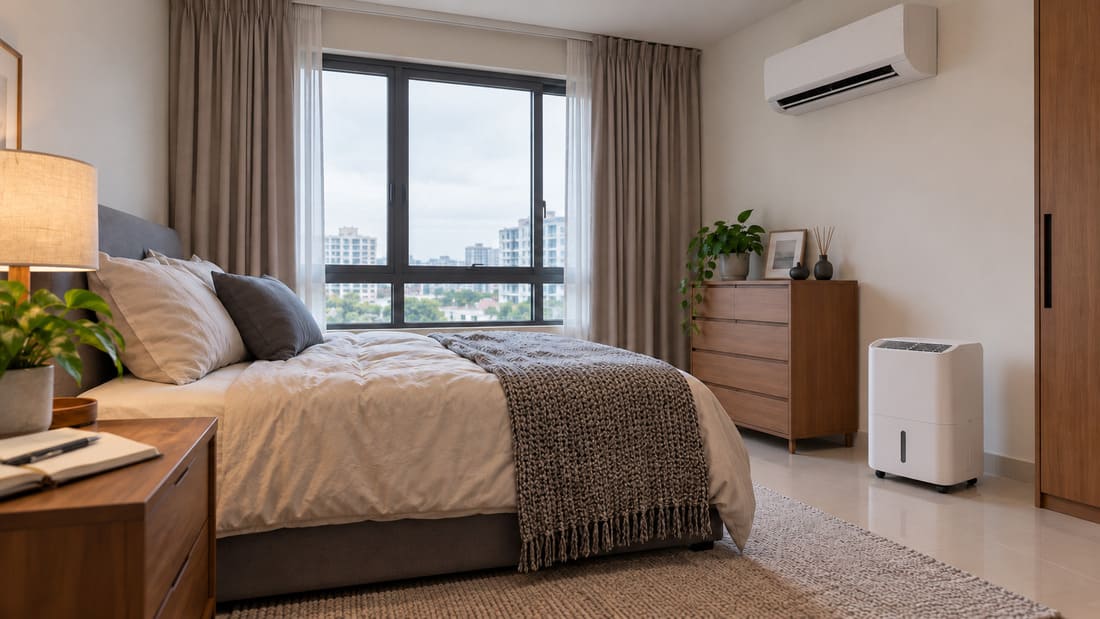
A conventional portable refrigerant dehumidifier collects condensed water and returns warmed air to the room. It is not a room cooler. That warmth may be acceptable in a damp spare room and less welcome in a bedroom that is already too warm.
The Dry button does not tell you the whole story
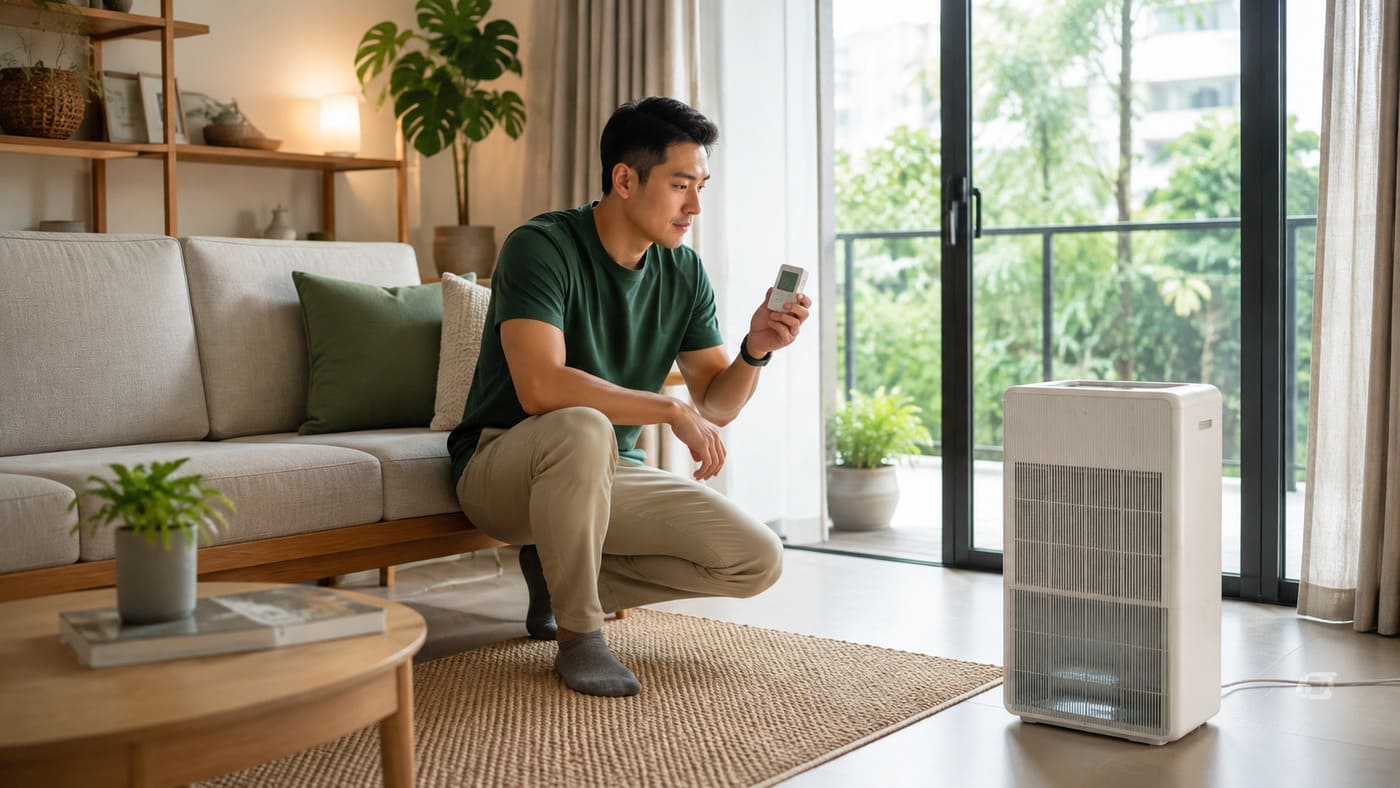
Find the model number on your indoor unit and open its operating manual. Look for what Dry mode allows you to adjust: temperature, fan speed, humidity or perhaps only a limited comfort setting. Do not assume the remote’s temperature display is a humidity target.
For example, Panasonic describes humidity-sensor control on selected air conditioners. That is a feature of the specified models, not something every aircond with a droplet icon includes. An older unit may follow a different control routine without letting you choose a relative-humidity percentage.
Before comparing with a separate appliance, write down three things: which settings your aircond offers, whether the room gets colder than you want, and whether it remains comfortable after the unit cycles. Those observations are more useful than choosing by the word “Dry” alone.
Which option fits your room?
| Your situation | A sensible starting point | What to check |
|---|---|---|
| Hot room that also feels humid | Use the aircond to meet the cooling need first. | Comfort and humidity after the temperature settles. |
| Comfortable temperature, occasional sticky evenings | Try the existing dry mode according to its manual. | Whether it overcools the room and which controls are available. |
| Damp room where you do not want cooling | Consider a separate dehumidifier. | Added warmth, noise, placement and water disposal. |
| Persistent wet wall or visible leak | Arrange an inspection and repair. | The water source; an appliance does not repair the building. |
These are starting points for a household decision, not a sizing chart. A unit that works well in a closed bedroom may not control moisture across a large open living area.
Try the appliance you already have
Choose an evening when you can observe the room. Note the starting temperature and humidity, the number of people present, and whether laundry is drying nearby. Use the manual’s recommended setup, then record how the room feels and how the readings change.
Keep the meter in the same place, away from the appliance outlet. Our indoor humidity measurement guide explains how to make the readings more useful. A falling temperature changes relative humidity too, so a single percentage is not a direct measure of how much water the machine removed.
Repeat on another reasonably similar evening before deciding. Weather, open doors and a fresh load of wet washing can make two sessions very different. This is a practical comfort check, not a controlled efficiency test.
Think about water, sound and floor space
Your installed aircond normally sends condensate through its drainage system. A portable dehumidifier commonly uses a removable tank or a hose, depending on the model. ENERGY STAR’s guidance highlights the need to plan a suitable drain location when using a hose.
Read the instructions for tank-full behaviour, hose routing and any pump requirement. A gravity drain cannot simply be routed uphill. Keep the appliance upright with the required clearance and choose a position where its sound will not interfere with sleep or work.
For regular indoor laundry, consider the drying routine as well as the equipment. Giving clothes enough space may be the first improvement to make; see our guide to drying laundry indoors. Avoid placing wet garments over either appliance.
Do not assume one always costs less
A smaller appliance or a different mode name does not establish the final electricity cost. Actual consumption depends on input power while running, cycling, operating time and the conditions you ask it to manage. A system with reheating may behave differently from a basic cooling-based dry mode.
Compare recorded kilowatt-hours over a useful period where suitable metering is available. Use a plug-in meter only if the appliance connection and electrical ratings allow it. Do not adapt a hardwired aircond to a plug-in meter; ask a qualified electrician about appropriate measurement.
Also compare the outcome. A cheaper session that leaves the room uncomfortable is not equivalent to one that meets your needs. Buying a second appliance adds an upfront cost even if you already own the aircond.
When buying a dehumidifier makes sense
If dry mode already gives you comfortable evenings, there may be no immediate reason to add another machine. If moisture control is needed at times when you do not want cooling, a separate unit gives you another option—provided the room can accommodate its warmth, sound and drainage.
Before choosing a size, read the dehumidifier buying guide. Keep leaks and recurring damp patches on a separate repair list. Managing room humidity can support a drier home, but it cannot fix water entering through a wall or pipe.
Frequently asked questions
Can I use both at the same time?
It may be appropriate for some rooms, but it is not automatically necessary or more economical. The dehumidifier releases heat that the aircond may then need to remove. Check the result, energy use and both manufacturers’ operating instructions.
Does dry mode mean I can set a humidity percentage?
Only if your model provides that control. Some air conditioners use automatic dry-mode routines with limited user adjustment. Check the exact operating manual before assuming the setting exists.
Sources and further reading
Sources checked on 11 October 2026.
- Daikin: cooling and dry-mode operation
- Panasonic Malaysia: dry mode with a humidity sensor
- ENERGY STAR: dehumidifier operation and drainage
- Meaco: dehumidifier basics