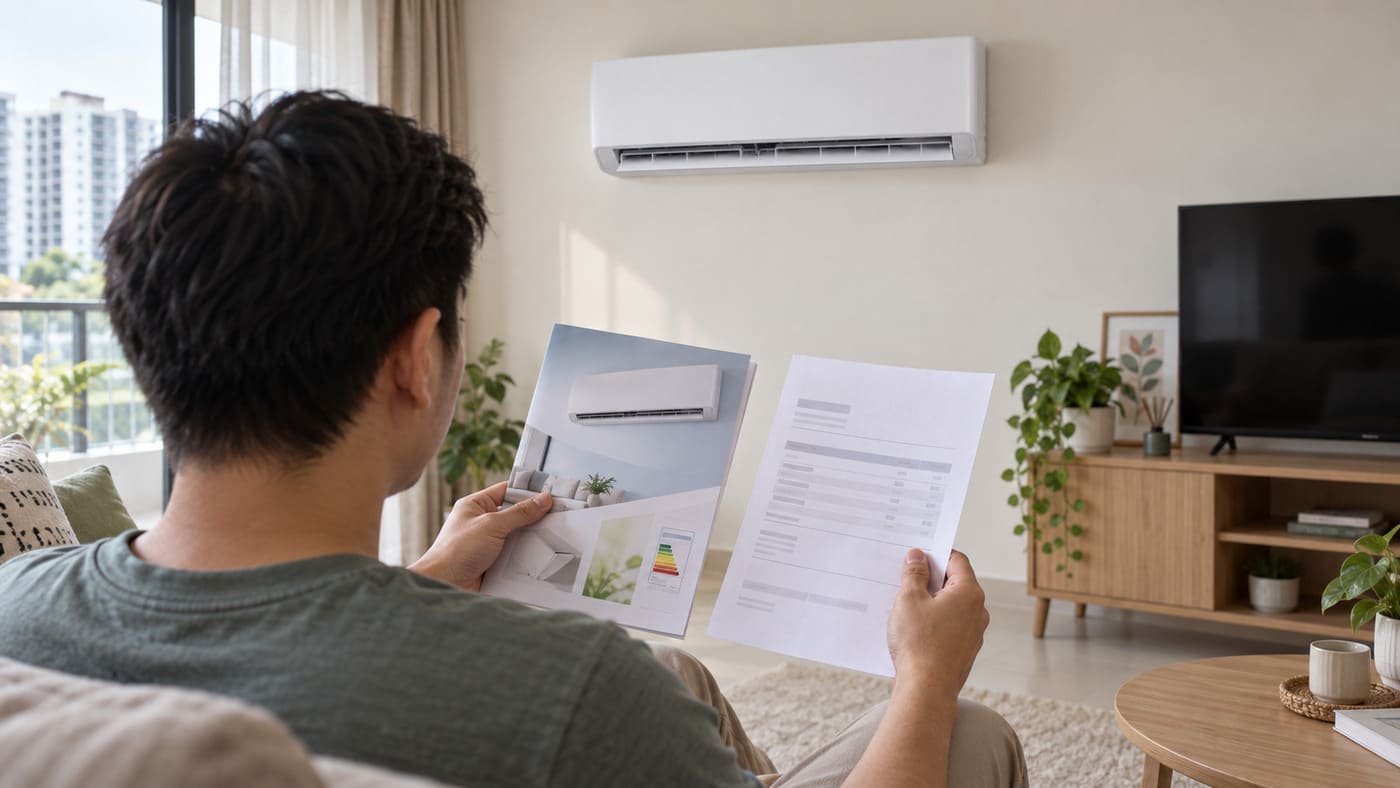
The Energy Commission lists an air-conditioner star-rating schedule for 1 January 2026–31 December 2029. Check the schedule applicable to the exact model, then compare capacity and efficiency together. A star rating is not a monthly bill estimate.
Start with the applicable schedule
The Energy Commission’s announcement identifies the 2026–2029 schedule and links to its implementation notice. A listing’s upload date does not establish which schedule applies to a particular unit. Ask for a clear label photograph and the exact model reference, then check the official product record.
For older stock or earlier labels, ask the seller to explain the applicable certification and transition conditions in writing. Do not infer compliance from a promotional badge. A changed rating framework also does not mean an existing machine has physically become less efficient.
This guide discusses the Energy Commission label. Confirm the applicable regulator and requirements for the purchase location, particularly in Sabah and Sarawak, rather than assuming all Malaysian appliance labels share one framework.
Read the label in this order
Reading guide — not an official label
- Model identity: match the label, quotation and indoor/outdoor unit combination.
- Rating schedule: establish the basis of the star comparison.
- Cooling capacity: compare models suitable for the same cooling requirement.
- Efficiency measure: read the metric and test basis, such as CSPF where shown.
- Energy consumption: check the units and operating assumptions.
Keep the label with your quotation. A dated model-specific record is more useful than a marketplace badge that can change after purchase.
What CSPF adds to the comparison
Cooling Seasonal Performance Factor, or CSPF, relates seasonal cooling delivered to energy consumed under the specified test method. A higher figure indicates greater efficiency on that basis. It is not cooling capacity and does not directly predict consumption in your bedroom.
Ask for the actual figure rather than relying only on the word “inverter”. If two labels use different efficiency metrics or test bases, do not compare the numbers directly. First establish that both figures answer the same question.
Make the quotation comparable
For each model, record its exact identity, applicable label schedule, cooling capacity, efficiency measure, installed price and service terms. Ask the installer to confirm that the selected capacity suits the room.
Imagine two offers for the same room: one costs less but omits the outdoor-unit reference; the other supplies matching model and label details. Ask the first seller to complete the missing information before judging efficiency. Missing evidence is not proof of poor performance, but it prevents a fair comparison.
Separate installation inclusions from the appliance price. Differences in piping, electrical work, warranty and maintenance can outweigh a small apparent saving.
Keep efficiency separate from the electricity bill
Operating hours, room conditions, installation and settings influence consumption. Electricity price is another variable. Choosing an efficient appliance and moving eligible usage to an off-peak tariff period are separate decisions.
For an illustrative calculation, suppose two comparable usage estimates differ by 10 kWh monthly. At an assumed RM0.40 per kWh, the difference is RM4 a month. RM0.40 is an example input, not your tariff. If the more efficient option costs RM300 extra, that simplified saving alone takes 75 months to recover the premium, excluding financing, repairs and future changes.
Our TNB Time-of-Use guide handles tariff suitability separately. Avoid treating a label as a fixed ringgit-saving promise.
Before paying a deposit
- Confirm the room’s cooling requirement with the installer.
- Match the quotation, supplied unit and energy-label model.
- Resolve questions about the applicable schedule or old stock.
- Keep installation and service terms in writing.
- Check any rebate against current applicant, model and programme conditions.
Keep the label photo, quotation and service terms together so you can check them later. If the label basis remains unclear, resolve it before comparing advertised savings.
Frequently asked questions
Does five star mean the lowest bill in every home?
No. The label compares efficiency under stated conditions. Capacity, room conditions, installation, operating hours and tariff affect the bill.
Can I compare old and new star labels directly?
First establish their schedules and underlying efficiency figures. A change in criteria can change the meaning of a star count.
Is inverter the same as five star?
No. Inverter describes a control technology. Check the exact model’s applicable label and efficiency data.
Sources and further reading
Sources checked on 11 September 2026.
- Energy Commission: 2026–2029 announcement
- Energy Commission: implementation notice (PDF)
- Energy Commission: product lookup
- SEDA: domestic programme eligibility
- Energy Commission: energy-using product guidelines and CSPF (PDF)