The largest motor figure or longest feature list does not decide whether a treadmill belongs in your home. Start with who will use it, how they intend to move and where the machine will remain between sessions.
Choose for the intended walking or running pace, test the usable belt and stability, measure the full operating and folded space, consider noise and floor vibration, and confirm service support before paying.
1. Define how the treadmill will be used
Walking, brisk walking, jogging and running place different demands on belt length, width, stability and continuous operation. List every intended user, their normal pace and the longest likely session. Do not buy only for the lightest user if others will share it.
If someone has an injury, chronic condition or has been inactive for a long time, obtain suitable health advice before beginning a new exercise programme. A treadmill is equipment, not a substitute for an individual exercise plan.
If compact walking equipment is also on the shortlist, compare a walking pad and a home treadmill by pace, stability, controls and operating space.
2. Test the usable deck and stability
The belt should allow a natural stride without the user feeling forced towards the front rail. Published dimensions help with shortlisting, but an in-person test is valuable because handrail position, belt response and frame movement affect confidence.
Try the machine at the speed and incline you actually expect to use. Listen for changes in sound and notice whether the deck feels stable when feet land away from the centre.
3. Measure operating and storage space
| Measurement | What to include | Why it matters |
|---|---|---|
| Operating length | Full frame plus safe entry and exit space | A folded specification is not enough |
| Width | Frame, handrails and side clearance | Users need room to step off safely |
| Height | Deck height, user height and ceiling | Incline raises the user further |
| Storage route | Doors, corners, lifts and floor changes | A heavy machine may not move easily |
A folding frame saves space only when the household will actually fold it and when the locking mechanism is understandable. Check the effort required rather than assuming one person can lift it safely.
4. Consider neighbours, vibration and heat
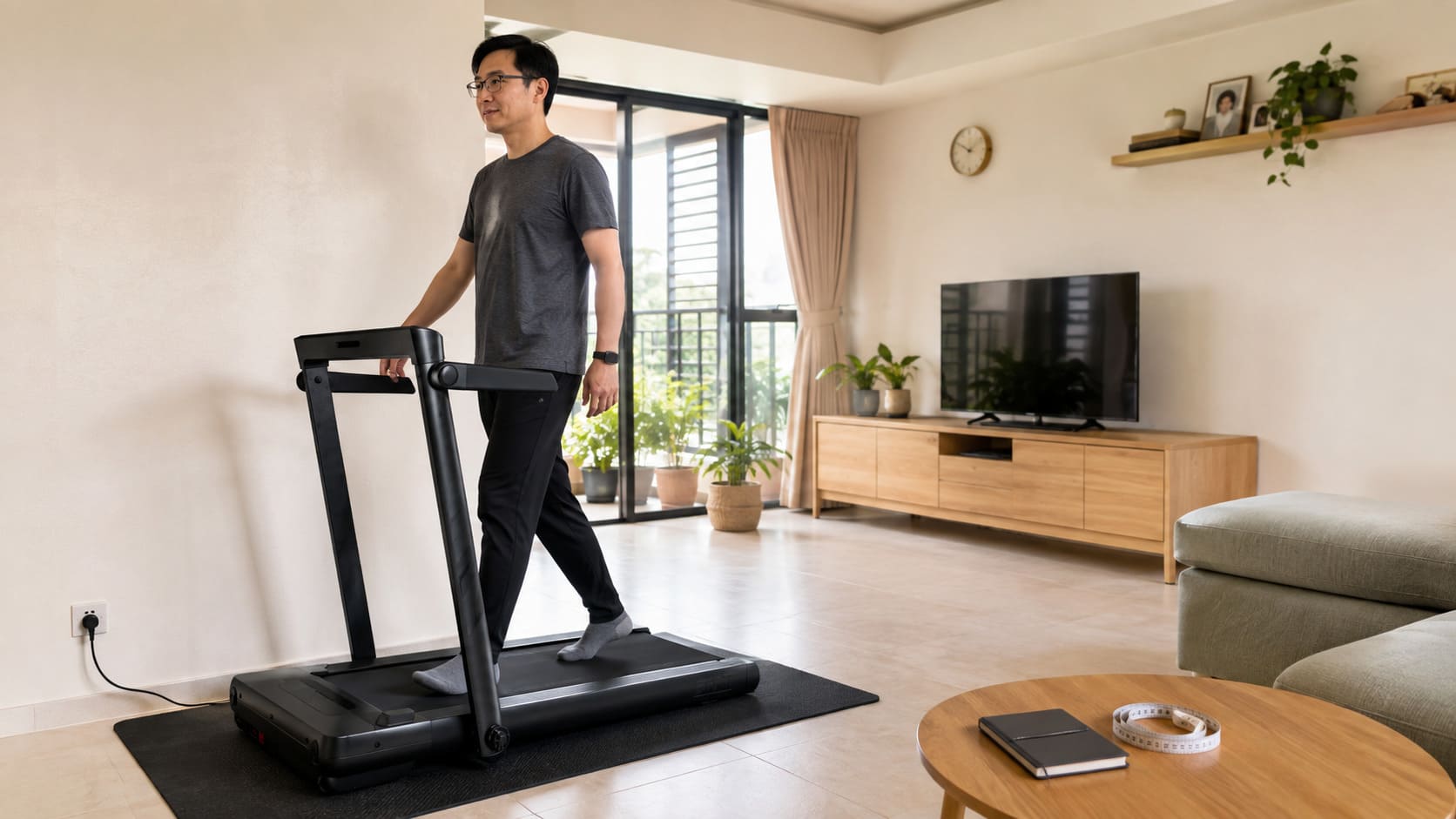
Motor noise is only one part of the sound. Footfall and frame vibration can travel through a hard condo floor. Test at realistic speed, discuss placement with the household and consider a suitable protective mat where the manufacturer permits one.
Keep ventilation around the motor clear. Malaysian rooms can be warm and humid, so follow operating and storage conditions and wipe perspiration from approved surfaces after use.
5. Look for clear controls and sensible safety features
- Speed and incline controls are reachable without losing balance.
- The display is readable during movement.
- Speed changes are predictable rather than abrupt.
- The emergency stop system is present and understood.
- Children cannot access or start the machine unsupervised.
- Handrails support entry and exit without restricting stride.
Do not treat automatic programmes or entertainment screens as essential unless they genuinely help the intended routine. Simple controls often make it easier to begin a session without delay.
6. Check delivery, servicing and spare parts
Confirm whether delivery includes stairs or lift access, assembly, positioning and packaging removal. Record the assembled size and weight before deciding where it will go.
Ask who handles faults, whether home visits are available, what parts are normally stocked and what routine lubrication or belt adjustment is expected. Warranty length means less when service arrangements are unclear.
7. Use a practical buying checklist
- Every intended user and activity level is listed.
- The deck supports a comfortable natural stride.
- The machine is stable at the intended pace.
- Operating, ceiling and access dimensions are measured.
- Noise and floor vibration have been considered.
- Controls and emergency stop are understood.
- Children and pets can be kept away safely.
- Delivery, assembly, maintenance and repair support are clear.
- The routine is realistic enough to continue after the first month.
The right treadmill is not necessarily the fastest. It is the one that supports safe, repeatable use in the space and schedule you really have.
After purchase, follow the home treadmill maintenance checklist for cleaning, belt care, inspections and service records.
Frequently asked questions
Is a folding treadmill suitable for a condo?
It may be, but measure the full operating footprint, ceiling clearance and storage route. Test how much effort folding and moving it requires.
Can a walking treadmill be used for running?
Only when the exact model is designed for the intended speed, user and session length. Do not assume that a higher displayed speed means the frame and deck suit running.
How can I reduce treadmill noise at home?
Choose a stable position, keep the machine maintained, test realistic footfall noise and use only a suitable mat or isolation method permitted by the manufacturer.
What should I test before buying?
Test entry, controls, belt response, natural stride, stability, noise and the emergency stop at the pace you expect to use.
Sources and further reading
- Ministry of Health Malaysia: Malaysian Physical Activity Guidelines
- Ministry of Health Malaysia: exercise information

Kelvin Chia
Active Living Contributor
Kelvin focuses on practical fitness equipment, hydration, recovery and routines that remain easy to maintain. View Kelvin’s profile.