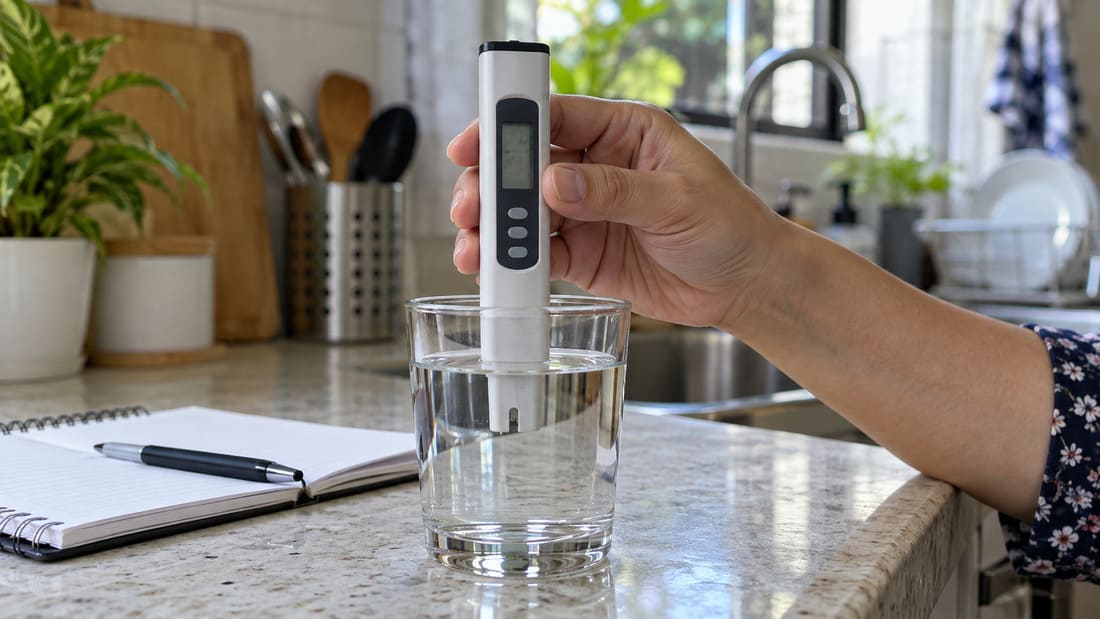
Most handheld TDS pens measure electrical conductivity and convert it into an estimated total dissolved solids value. The number does not identify individual substances or test for bacteria. Use it to follow trends under consistent conditions, not to declare drinking water safe or rank every filter by the lowest reading.
What the number on a TDS pen represents
TDS stands for total dissolved solids. Dissolved substances include mineral salts; they are not the same thing as visible sediment floating in a glass. Many common dissolved ions contribute to electrical conductivity.
A typical household TDS pen measures conductivity and applies a conversion factor to estimate TDS. Hanna Instruments explains that this is an indirect measurement. The factor and temperature handling matter, so two meters can show different TDS estimates for the same sample.
Displays often use ppm, or parts per million. In dilute water, the numerical value is approximately equivalent to mg/L. Neither unit turns the reading into a list of ingredients. The pen cannot tell you how much of the displayed total comes from calcium, sodium or a particular unwanted substance.
Why a low number does not prove water is safe
A conductivity-based reading is not a microbiological test or a contaminant-specific chemical analysis. It does not establish the absence of bacteria, viruses, lead, pesticides or other individual hazards. Some substances of concern can be present at concentrations too small for a general TDS change to be informative.
EPA distinguishes physical, chemical, biological and radiological drinking-water contaminants. One aggregate reading cannot assess all those categories. Equally, a higher reading can reflect dissolved minerals rather than proving that a glass is dangerous.
A seller placing a pen in two samples has demonstrated two readings under those conditions. That demonstration alone does not establish the safety of either sample or confirm every performance claim made for the purifier.
Be careful with online “safe TDS” charts
A coloured chart that labels every low reading safe and every high reading unsafe leaves out what the dissolved substances actually are. Do not use it as a drinking-water safety test.
For context, the US EPA lists 500mg/L for TDS as a secondary guideline addressing aesthetic or nuisance effects. It is not a universal health pass mark, and it is not a Malaysian regulatory limit. A sample below that number can still need assessment for a specific concern.
For your home, follow guidance from the relevant Malaysian water supplier or health authority. If an advisory is in place, a reassuring-looking meter number does not override it.
Different filters have different jobs
Reverse osmosis can reduce dissolved solids, so a TDS trend can be useful when following the manufacturer’s checks for an RO system. However, the reading is only one operating indicator, not proof that every treatment stage is working or that the water is safe.
A filter selected for a particular taste, odour or contaminant-reduction claim may do its intended job without a large change in TDS. Judge it against that claim and its instructions, rather than assuming all filters should make the display approach zero.
For example, two readings of 120ppm before a filter and 118ppm afterwards do not, by themselves, prove that the filter has failed. These are invented values to illustrate the limitation. You would need to know what the filter is intended to reduce and how that performance should be checked.
The RO versus non-RO guide explains the technology choice. To verify a seller’s specific reduction claim, use the certification-checking guide.
Make repeat readings more useful
Start with the meter’s manual. Follow its calibration, rinsing, immersion-depth and temperature instructions; a pen intended for cool water should not be dipped into a hot-water dispenser.
Use a clean sample container, avoid detergent residue and let the reading settle as instructed. Keep the sampling point and procedure consistent. When comparing two samples, use the same meter and record any relevant temperature difference.
Write down the date, source, displayed units and result, along with changes such as a new cartridge or recent servicing. Do not compare a reading at one point in the treatment path with a different point without noting it. Mineral-adding stages, where fitted, can also change the outlet reading.
A sudden change is a reason to check the procedure and the equipment instructions. Repeat the reading, check the meter’s condition and ask the supplier what follow-up is appropriate for that model. Do not invent a universal cartridge-replacement threshold.
Match the next step to the question
| Your question | Useful next step |
|---|---|
| Has the reading changed? | Repeat with the same meter and sampling method; record the conditions. |
| Is the RO system behaving as expected? | Follow the model’s operating checks and ask the service provider about an unexplained trend. |
| Does this filter reduce a named contaminant? | Check the exact certified claim and, where needed, appropriate performance testing. |
| Is my tap water safe to drink? | Consult the supplier or relevant authority and arrange suitable laboratory tests for the concern. |
If testing is needed, ask the laboratory which analyses and sampling method fit the problem. Obtain its containers and collection instructions before taking the sample; a casually filled kitchen bottle may not be suitable for the requested test.
For a suspected contamination incident or an official notice, follow the authority’s instructions about water use. Do not taste questionable water to confirm a meter result.
Keep the meter in its proper role
A TDS pen can be a convenient way to record an operating trend. It should sit alongside the purifier’s instructions, service history and any relevant laboratory results.
Keep replacing and maintaining components according to the applicable instructions even if the display stays low. Our water-purifier maintenance guide covers the household routine. A steady number is useful information; it is not a substitute for that routine.
Frequently asked questions
Does zero TDS mean sterile water?
No. A zero or very low display is limited by the meter’s method, range and resolution. It does not test for microorganisms or establish that water is sterile.
Should I replace a carbon filter when TDS rises?
Do not use TDS alone as the replacement trigger. Follow the filter’s specified service life, capacity and maintenance instructions, and investigate an unexpected change with the supplier.
Sources and further reading
Sources checked on 11 October 2026.
- Hanna Instruments: conductivity and indirect TDS measurement
- US EPA: types of drinking-water contaminants
- US EPA: secondary drinking-water guidelines
- US EPA: drinking-water treatment technologies